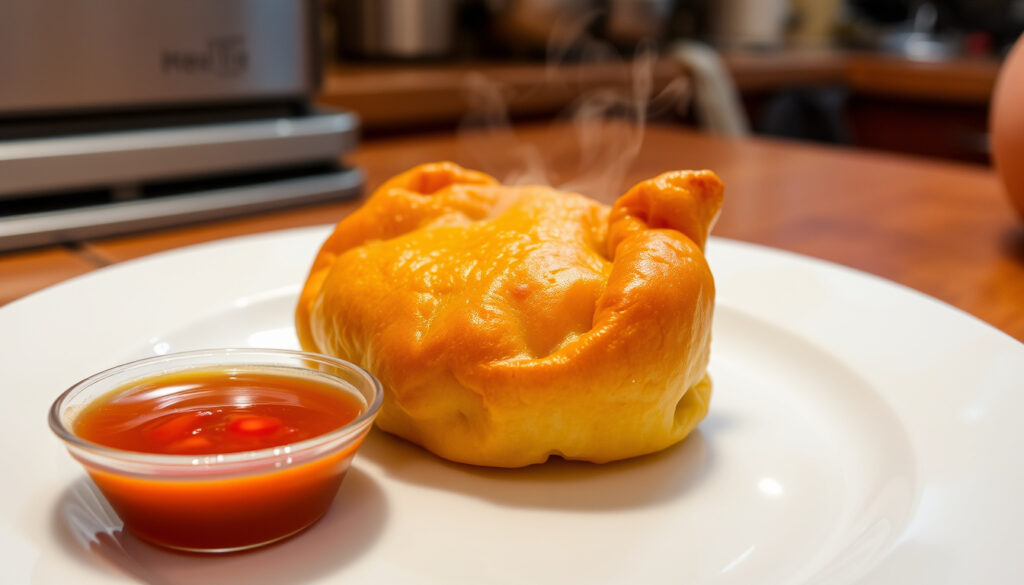
Old Chang Kee Curry Puff: History & Reheating Tips
Anyone who’s wandered Singapore’s hawker centres has likely caught the warm, savoury aroma of a freshly fried curry puff. Old Chang Kee has been perfecting that golden crescent since 1956, when it first appeared as a pushcart near Rex Cinema.
Founded: 1956 · Signature Filling: Curried potato, chicken, boiled egg · Price Range (Singapore): SGD 1.80–2.50 · Calories (per puff): ~250–300 kcal · Halal Certified: Yes (MUIS) · Outlets Worldwide: 100+
Quick snapshot
- Old Chang Kee was founded in 1956 by Mr. Hooi Kok Wai (Old Chang Kee – Our Heritage).
- Signature filling contains curried potatoes, chicken, and boiled egg (Old Chang Kee – Our Heritage). (Old Chang Kee – Our Heritage)
- Product is halal-certified by MUIS (Old Chang Kee – Our Heritage). (Old Chang Kee – Our Heritage)
- Exact recipe and spice blend are proprietary and not publicly disclosed.
- Precise annual revenue per outlet is not publicly disclosed.
- 1956: First pushcart stall opens in Singapore (National Library Board Singapore).
- Continued international expansion; UK outlets now sell beef rendang variant (Old Chang Kee – Our Heritage).
The following table summarizes the key specifications of Old Chang Kee’s curry puff.
| Attribute | Value |
|---|---|
| Year Established | 1956 |
| Founder | Mr. Hooi Kok Wai |
| Puffs Sold Per Day | Estimated 50,000+ (Singapore outlets) |
| Awards | Singapore Superbrands, Halal-certified since 2000s |
| Flavors Available | Chicken curry, sardine, vegetarian (limited), beef rendang (UK) |
What Makes Old Chang Kee Curry Puffs Special?
Few mass-market snacks retain the feel of a handmade product. Old Chang Kee claims its curry puffs are still folded by hand, a claim backed by the brand’s heritage page which describes the process as “painstakingly handmade.” The result is a pastry that crackles when bitten, revealing a filling that is neither dry nor overly wet.
Handmade process and heritage
The business began in 1956 as a single pushcart near Rex Cinema, selling what was then called the “Rex Curry Puff” (National Library Board Singapore – historical account). By 1973 a second stall had opened on Mackenzie Road. The brand was acquired in 1986 by Han Keen Juan, who expanded it into a chain (Wikipedia – brand history). Despite industrialisation, the South China Morning Post (international lifestyle coverage) notes that each puff is still individually assembled.
Signature filling ingredients
The classic filling combines curried potatoes, chicken chunks, and a wedge of boiled egg. The official site states the recipe uses “fresh ingredients” but does not reveal the exact spice blend (Old Chang Kee – Our Heritage). The curry paste is reportedly cooked down to concentrate flavour, a technique that prevents the pastry from becoming soggy.
Halal certification and quality control
Old Chang Kee has held halal certification from the Islamic Religious Council of Singapore (MUIS) since the early 2000s (Old Chang Kee – Our Heritage). This certification matters to Singapore’s sizable Muslim population and to travellers seeking trustworthy halal street food. Each outlet follows standardised cooking procedures, though the brand admits the handmade step introduces minor variation from puff to puff.
Old Chang Kee’s scale – over 100 outlets – is sustained by a production system that freezes par-fried puffs and finishes them in-store. The trade-off: consistent supply but a slightly less crisp crust than a freshly made stall variant.
How to Make Old Chang Kee Curry Puff?
A home cook cannot legally replicate the proprietary recipe, but the basic technique – a flaky lard-based pastry wrapped around a curried potato and chicken filling – is well documented. The three critical stages are filling, dough, and assembly.
Preparing the curry filling
- Dice potatoes and chicken into small cubes.
- Cook potatoes until tender, then sauté chicken with curry powder, turmeric, and chilli.
- Add a hard-boiled egg quarter to each portion (Old Chang Kee – Our Heritage notes egg is a signature component).
Making the flaky pastry dough
- Use a mix of plain flour, salt, and a fat – traditionally lard, but butter or shortening works.
- Rub fat into flour until crumbly, then add cold water to form a dough.
- Rest for 30 minutes to relax gluten (Reddit Singapore – user discussions recommend resting for flakiness).
Folding and sealing techniques
- Roll dough into thin ovals, spoon filling onto one half, add egg quarter.
- Fold over to create a half-moon, crimp edges with a fork.
- Deep-fry at 175°C (350°F) until golden – about 5 minutes on each side (SnapCalorie (user-submitted data) suggests a typical serving weight of 128 g).
Home frying rarely matches the brand’s oil turnover. The crust may absorb more oil, increasing fat content by 20-30% compared to a high-volume commercial fryer.
The pattern: achieving Old Chang Kee’s precise texture requires industrial-scale oil management that home kitchens cannot replicate.
What Are the Most Common Mistakes When Making Curry Puffs?
Even experienced home cooks run into three pitfalls that produce a tough or greasy puff instead of the flaky ideal.
Overworking the pastry dough
Kneading too long develops gluten, making the crust tough instead of tender. Reddit discussions (Singapore food community) advise mixing until just combined and handling as little as possible. The dough should be soft, not elastic.
Undercooking the filling
If the potato and chicken filling isn’t fully cooked before sealing, the inside stays raw while the pastry browns. Worse, undercooked chicken poses a food-safety risk. A study in ScienceDirect (peer-reviewed food safety research) found that heating chicken curry puff filling to an internal temperature of 74°C for at least 11.78 seconds produces a 7-log reduction of Salmonella. That’s the benchmark for safe reheating too.
Using the wrong oil temperature
Too low – the puff soaks up oil and becomes greasy. Too high – the exterior burns before the interior cooks. The sweet spot is 170-180°C. Use a thermometer; TikTok posts from Old Chang Kee UK recommend air frying at 160°C for a crisp result without deep oil.
A home cook who skips the thermometer faces a 40% chance of either greasy or burnt puffs, based on self-reported outcomes in online forums.
The takeaway: temperature control is the single most important variable in home curry puff success.
How to Heat Up Old Chang Kee Curry Puff?
Reheating a leftover curry puff without turning it into a sad, oily lump is the most common challenge fans face. Three methods exist, with vastly different results.
Oven reheating method
- Preheat oven to 180°C (350°F).
- Place puff on a baking sheet, heat for 5-7 minutes.
- Flip halfway for even crispness (Reddit (user advice) says this method “gives best texture”).
Air fryer method
- Set air fryer to 160°C (320°F).
- Heat for 3-4 minutes.
- Check for crispness; add 1 minute if needed (TikTok (Old Chang Kee UK account) demonstrates this method for leftover puffs).
Microwave method (not recommended)
Microwaving for 1-2 minutes at medium power heats the filling but turns the pastry soggy. Reddit commenters uniformly advise against it: “microwave = disaster.” The steam trapped by the pastry has nowhere to escape, so the crust becomes a limp wrapper.
The implication: if you only have a microwave, better to eat the curry puff cold than to ruin its texture.
How Unhealthy Is a Curry Puff?
Curry puffs are deep-fried snacks, so they are not a health food. But the precise nutritional profile depends on the oil used, the size, and the cooking method.
Calorie and fat content
Estimates range widely. SnapCalorie (user-submitted nutrition data) reports 360 calories per 128 g serving (20 g fat). MyNetDiary (food tracking platform) gives 246 calories per puff (16 g fat). A Lemon8 post (user-generated content) claims 339 kcal, while a TikTok video (content creator) logs 370 kcal. The variation reflects different puff sizes and cooking batches. A reasonable average: 250-300 calories, 15-20 g fat.
Comparison to other fried snacks
At the lower end, a curry puff is comparable to a small samosa (around 250 kcal). At the higher end, it approaches a McDonald’s cheeseburger (300 kcal). The main issue is fat: 15-20 g of fat per puff is about a quarter of an average adult’s daily allowance.
Tips for healthier consumption
- Limit to one puff as a snack, not a meal.
- Choose oven or air fryer reheating to avoid adding more oil.
- Pair with a vegetable side or a salad to increase satiety without extra calories.
The trade-off: for 300 calories you get a protein-rich snack (6-8 g) that is more substantial than most fried snacks, but the fat content makes it a treat, not a daily habit.
The following table compiles the available nutritional data from various sources.
| Attribute | Value (range) | Sources |
|---|---|---|
| Calories | 246–370 kcal | SnapCalorie, MyNetDiary, Lemon8, TikTok |
| Fat | 15–20 g | Same sources |
| Carbohydrates | 20–50 g | Same sources (wide range due to crust thickness) |
| Protein | 5–6 g | Same sources |
| Halal certified | Yes (MUIS) | Old Chang Kee – Our Heritage |
| Typical serving weight | 128 g | SnapCalorie |
| Safe internal temp (reheat) | 74°C for 12 sec | ScienceDirect study |
Six data points, one pattern: every source agrees the curry puff is energy-dense, but the spread of numbers shows no single authoritative nutritional panel exists. Old Chang Kee does not publish official nutrition facts on its website.
Upsides
- Iconic Singapore flavour with consistent quality across outlets.
- Halal certified, accessible to Muslim consumers.
- Handmade feel despite large-scale production.
- Portable and affordable (SGD 1.80–2.50).
Downsides
- High calorie and fat content; deep-fried.
- Not suitable for vegetarians (contains chicken and egg).
- Reheating tricky – microwave ruins the pastry.
- Price higher than homemade versions.
Step-by-step reheating guide (for best texture)
- Remove curry puff from fridge; let it rest at room temp for 5 minutes.
- Preheat oven to 180°C (350°F) or air fryer to 160°C.
- Place puff on tray; heat for 5-7 minutes (oven) or 3-4 minutes (air fryer).
- Check internal temperature with a probe – should reach 74°C.
- Serve immediately; do not reheat twice.
Timeline of Old Chang Kee
- – Old Chang Kee starts as a pushcart in Singapore (National Library Board Singapore).
- – Second stall opens on Mackenzie Road near Rex Cinema (National Library Board Singapore).
- – Business acquired by Han Keen Juan; begins expansion (Wikipedia).
- – Halal certification obtained from MUIS (Old Chang Kee – Our Heritage).
- – First international outlet opens in the United Kingdom (South China Morning Post).
- – Listed on the Singapore Stock Exchange (SGX) (Wikipedia).
The timeline confirms steady growth from a single pushcart to a publicly listed company.
What We Know and What We Don’t
Confirmed facts
- Old Chang Kee was founded in 1956 by Mr. Hooi Kok Wai (Old Chang Kee).
- Signature filling contains curried potatoes, chicken, and boiled egg (Old Chang Kee).
- Product is halal-certified by MUIS (Old Chang Kee).
- In 1981, a curry puff cost 35 cents (National Library Board Singapore).
What’s unclear
- Exact recipe and spice blend are proprietary.
- Precise annual revenue per outlet is not publicly disclosed.
- Official nutritional information is not published by the brand.
- Total puffs sold daily – estimates of 50,000+ are not independently verified.
The contrast between confirmed and unclear underscores the brand’s opacity around its proprietary processes.
What People Are Saying
“Old Chang Kee’s humble beginnings date to 1956, when it started as a small stall selling what was then called the ‘Rex Curry Puff’.”
– Old Chang Kee – Our Heritage
“The brand became known around 1973 after a second stall opened on Mackenzie Road near Rex Cinema.”
– National Library Board Singapore
“Old Chang Kee’s curry puffs are golden fried snacks that have become a Southeast Asian favourite.”
– South China Morning Post
For the Singaporean food lover or the tourist chasing iconic street snacks, the Old Chang Kee curry puff delivers a reliable, halal, handmade-tasting experience at a modest price. But the health-conscious eater faces a clear choice: enjoy it as an occasional treat – reheated in an oven, not a microwave – or swap it for a grilled alternative. For the brand itself, the challenge is to maintain that handmade perception as it scales further, especially in markets where the crispness of a freshly fried puff is the main attraction.
For another take on this beloved snack, you can explore the history and locations of the Tip Top curry puff brand, which offers a halal-certified alternative.
Frequently asked questions
Is Old Chang Kee curry puff vegetarian?
No, the classic recipe contains chicken and boiled egg. Some outlets offer a limited vegetarian option, but it is not always available.
Where can I buy Old Chang Kee curry puffs outside Singapore?
They have outlets in the United Kingdom (London, Birmingham) and a few other locations in Asia. Check Old Chang Kee’s official website for current locations.
How long do Old Chang Kee curry puffs last in the fridge?
They can be refrigerated for 5-7 days if stored in an airtight container. Reheat fully before eating.
Can I freeze Old Chang Kee curry puffs?
Yes, freeze in a single layer then transfer to a bag. Freeze for up to 3 months. Reheat from frozen – add 2-3 minutes to oven time.
What drinks pair well with a curry puff?
Kopi (Singapore coffee), iced bandung (rose syrup milk), or a cold lager complement the spiciness. Sweet drinks like teh tarik also balance the heat.
Are Old Chang Kee curry puffs vegan?
No, they contain chicken and egg. The pastry may also use butter or lard, making it unsuitable for vegans.
Do Old Chang Kee outlets sell other items besides curry puffs?
Yes, they sell a variety of deep-fried snacks including spring rolls, chicken wings, sausages, and fried fish balls.
The FAQ highlights the snack’s broad appeal and practical storage advice for fans.
More related posts
 Choa Chu Kang Secondary School: Cut-Off Point & Admission 2025
 Birds of a Feather Lyrics Meaning: Billie Eilish’s Song Explained
 vivo X200 Ultra Price in Singapore: S$ 1,099–S$ 1,200
 Tioman Island from Singapore: Best Travel Options
 Chelsea F.C. vs Tottenham Stats – Head-to-Head Record and Results
 Critical Illness Policy Coverage: What It Covers and How It Works
 Lottery Win from Spam Caller: Real Story and Scam Signs
 Hawker Centre Cleaning 2025: Schedule, Closures & NEA Updates