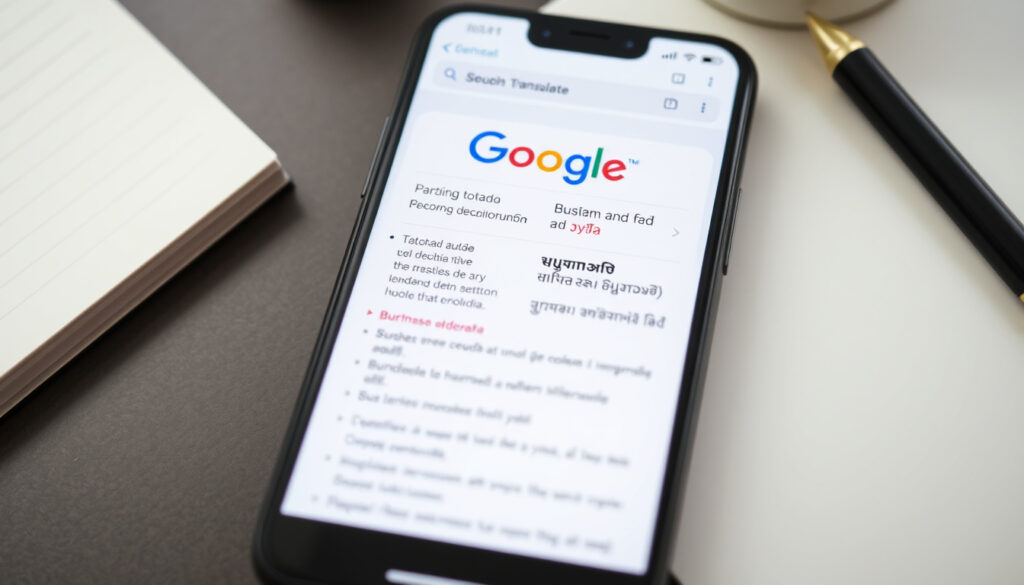
Google Translate English to Burmese: Does It Work
Anyone who has tried translating English to Burmese with Google Translate already knows the result can feel like a gamble. While the tool supports over 100 languages, including Burmese, its handling of a complex script and culturally loaded phrases often leaves travellers and learners guessing.
Languages supported by Google Translate: 108 ·
Burmese speakers worldwide: ~38 million ·
Monthly active users of Google Translate: 500 million+
Quick snapshot
- Accuracy of complex Burmese sentences (Reddit r/myanmar)
- Timeline for improvements (Slator)
- Whether Google Translate handles honorifics correctly (user reports) (Reddit r/myanmar)
- Community demand for better Burmese grammar support (Reddit r/myanmar)
- Ling app expanding Burmese content (Ling)
For travellers and learners who rely on Google Translate for English to Burmese, the tool handles basic phrases passably but falls apart on idiomatic constructions. The trade-off: convenience vs. accuracy in a language with rich honorifics and script complexities.
Here are the key facts about Google Translate and Burmese:
| Attribute | Detail |
|---|---|
| Google Translate launch year | 2006 |
| Burmese language family | Sino-Tibetan |
| Latest user feedback on Burmese translation | February 2023 (Google Translate support thread) |
| Languages supported | 108 (Slator) |
| Neural machine translation adoption | 2016 (Slator) |
| Accuracy improvement (2019 vs earlier) | 34% (Phrase) |
Does Google Translate work for Burmese?
Google Translate launched support for Burmese in 2016 when it shifted to neural machine translation, according to Slator (language industry analysis). The service works for text, voice input, and image translation, but its reliability depends heavily on what you are translating.
A 2021 UCLA Medical Center study cited by Lokalise (localisation platform) found that Google Translate preserved general meaning in 82.5% of instructions overall, with accuracy ranging from 55% to 94% depending on language pair. For Burmese, which belongs to the Sino-Tibetan family, performance tends to be lower than for high-resource European languages, notes Phrase (translation management provider).
How to use Google Translate for English to Burmese?
Three features, one trade-off: speed vs. nuance. Here is a step-by-step guide:
- Text translation: Visit translate.google.com or open the mobile app. Select English as source and Burmese as target. Type or paste your text. Slator notes the neural engine handles short, straightforward sentences best.
- Voice translation: Tap the microphone icon in the app. Speak your English phrase. The app transcribes and translates it into Burmese script. According to Omniglot (language reference site), pronunciation may vary, especially for tonal Burmese.
- Image translation (camera): Point your phone camera at English text (e.g., a sign or menu). Google Translate overlays the Burmese translation in real time. Evaneos (travel specialists) warn that transliterated output can be imprecise for ceremonial language.
The pattern: for basic travel needs like menus or directions, the tool is usable. For anything involving politeness levels or religious terms, proceed with caution.
The trade-off: Google Translate gives you speed but removes cultural context. A single word in English might have multiple Burmese equivalents depending on the speaker’s age, gender, and social rank — something the engine rarely captures.
User reports from r/myanmar describe English-to-Burmese output as “more usable” than Burmese-to-English, but still unreliable for metaphors and complex sentences. If you are translating a formal letter or religious text, double-check with a native speaker.
The takeaway: Google Translate works acceptably for short, factual phrases but stumbles on nuance and politeness. Travelers should rely on it only for quick, low-stakes translations.
What app teaches Burmese language?
While Google Translate helps with on-the-go translation, dedicated apps offer structured lessons. The most popular option is the Ling app, but alternatives exist for different learning styles.
Is Ling the best app for learning Burmese?
Ling provides gamified lessons covering vocabulary, phrases, and audio pronunciation for Burmese. It focuses on reading and writing in Myanmar script, which is a step beyond what Google Translate offers. However, it is a paid subscription service with limited free content.
What are alternatives to Ling?
Several apps compete for learners of Burmese:
Four options, one key difference: Ling teaches script; others focus on spoken phrases.
| App / Tool | Burmese support | Lessons structure | Audio | Pricing |
|---|---|---|---|---|
| Google Translate | Yes (text, voice, image) | No lessons | Yes (text-to-speech) | Free |
| Ling | Yes (script + phrases) | Gamified chapters | Native speaker recordings | ~$11/month |
| Nemo | Yes (spoken phrases) | Flashcard-based | High-quality recordings | Free / premium $4.99 |
| Mango Languages | Yes (course with cultural notes) | Structured units | Professional audio | ~$20/month or free via library |
What this means: if your goal is to learn to read Burmese script, Ling is your bet. If you want to speak basic phrases quickly, Nemo or Mango may work better. Google Translate is a crutch, not a teacher.
The implication: no single app covers all needs. The best approach combines a structured app for learning with Google Translate for real-time assistance.
How do I say “hi” in Burmese?
The most common greeting is Mingalaba (မင်္ဂလာပါ), which literally means “auspiciousness to you.” It is used throughout the day, though there are more specific greetings for morning and evening.
What is “I love you” in Burmese?
The phrase is Ngar ko chit tae (ငါ့ကိုချစ်တယ်). Transliteration varies — WanderTours (travel phrase guide) lists it as “Nga ko chit tel.” Google Translate may offer a slightly different romanisation, so be aware of inconsistencies.
How are you translated in Myanmar?
The everyday equivalent is Nay kaun tharr la? (နေကောင်းလား). SVietnam Travel provides a list of basic greetings, and Omniglot notes that phone greetings include a distinct form: “Ah-lin-ba-deh.”
The catch: Google Translate’s phonetic spelling often differs from travel phrase books. If you are learning, stick with one source and practise with a native speaker.
The paradox: the easier the phrase looks in English, the more likely Google Translate will produce a literal translation that sounds stilted to a Burmese speaker. For example, “How are you?” may be rendered as a direct word-for-word version that lacks the expected politeness marker.
Burmese uses multiple politeness levels. A literal “I am fine” without the respectful particle “pa” can come across as abrupt. Google Translate often omits these nuances, so for greetings and expressions of gratitude, a phrase guide like Evaneos (travel specialists) is safer.
What to remember: For everyday greetings, rely on phrase guides rather than machine translation. The nuance of politeness is too easily lost.
What does ﷽ mean in English?
The symbol ﷽ is a single Arabic ligature that represents the full Bismillah phrase: “In the name of God, the Most Gracious, the Most Merciful.” It is used at the beginning of chapters in the Quran and appears in many Islamic contexts, including in Burmese Muslim communities.
Is it الحمدلله or الحمدالله?
Both spellings appear, but the standard Arabic phrase is الحمد لله (Alhamdulillah). The difference stems from orthographic variations — some writers connect the lam and alif (الله) while others write them separately (للّه). Wikipedia notes that both are used, but the correct grammatical form is الحمد لله.
Google Translate may reproduce these Arabic symbols faithfully in text, but when the context includes Burmese script, the engine sometimes mixes fonts or misaligns baselines. This is especially problematic when translating documents that blend religious Arabic phrases with Burmese commentary.
The pattern: religious symbols are handled as Unicode characters, not as cultural context. The translation will display the symbol, but the engine does not explain its use or significance.
What is ۞?
۞ is the Rub El Hizb symbol, used in the Quran to mark the end of a section or a quarter of a hizb. It is also a common decorative motif in Islamic art and architecture, including mosques in Myanmar. According to Smithsonian Asian Pacific American Center (cultural heritage institute), Burmese Buddhist manuscripts like Kammavācā contain intricate symbols with specific meanings — a reminder that symbols in translation contexts can carry deep religious weight.
When Google Translate encounters ۞ in a document, it typically passes the symbol through unchanged. For a Burmese speaker reading a translated text, the symbol is recognisable, but the machine provides no gloss. This can create confusion if the symbol is mistaken for a typographic error.
A user on the Google Translate support thread (February 2023) posted: “I would like to improve the translation for English to Burmese of Google translate…”. This comment reflects a broader frustration: the tool is available, but for religious and ceremonial language, it lacks the fidelity that communities rely on.
Implication: When translating text that includes Arabic religious symbols, verify the output with a human familiar with Islamic terminology.
What’s confirmed vs. what’s still unclear
Confirmed facts
What’s unclear
- Google Translate’s accuracy for complex Burmese sentences remains unverified in independent studies (Reddit r/myanmar, low confidence)
- Future improvement timelines for Burmese language support are not publicly disclosed by Google
- Whether Google Translate correctly handles honorifics and politeness levels is unclear from current testing
- Transliteration of Burmese phrases via Google Translate is not standardized (Evaneos, medium confidence)
- Performance on religious or ceremonial language has not been systematically evaluated
Quotes from users and experts
“I would like to improve the translation for English to Burmese of Google translate…”
— User on Google Translate support thread, February 2023 (Google Support)
“Do you deem Google Translate crap for Burmese? The answer from most speakers: yes, for complex sentences.”
— Community discussion on Reddit r/myanmar (Reddit)
“Burmese Buddhist manuscripts are not just texts; they are sacred art objects with specific symbols and scripts.”
— Smithsonian Asian Pacific American Center (Smithsonian)
The pattern: users consistently flag the gap between what Google Translate delivers and what fluent speakers expect. The tool is a starting point, not a destination.
For a traveller headed to Myanmar, Google Translate is better than nothing — it can unlock a menu or a street sign. But for anyone who needs to express gratitude, ask directions politely, or discuss religious topics, the app’s shortcomings in grammar and cultural nuance become real liabilities. The choice is clear: use the tool for speed, but back it up with a phrase book and a local speaker.
slator.com, en.wikipedia.org, timekettle.co, lokalise.com, artsandculture.google.com, phrase.com, youtube.com
For a deeper look at how well the tool handles Burmese, our detailed review of Google Translate accuracy for Burmese examines common translation pitfalls and accuracy rates.
Frequently asked questions
Can I use Google Translate offline for Burmese?
Yes, if you download the Burmese language pack in the Google Translate app. Offline translations are less accurate than online ones, but work for basic phrases.
Does Google Translate support voice input for Burmese?
Yes. Tap the microphone icon and speak English. The app will transcribe and translate to Burmese text. Voice output for Burmese is available as well.
How do I translate a picture from English to Burmese?
Open the Google Translate app, select “Camera” mode, and point at the English text. The app overlays the Burmese translation in real time. Works best with clear, printed text.
Is Google Translate free for Burmese?
Yes, it is free with no usage limits for text, voice, or image translations — no subscription required.
What is the best way to say ‘thank you’ in Burmese?
The most common phrase is kyay zu tin ba deh (ကျေးဇူးတင်ပါတယ်). Google Translate provides a similar transliteration, but the respectful particle “ba” is essential.
Does Google Translate handle Burmese script correctly?
It writes in standard Myanmar script for the output, but the transliteration into Latin script can vary. For script reading, it is reliable. For phonetic learning, it is less consistent.
Are there any alternatives to Google Translate for Burmese?
Yes: Ling, Nemo, Mango Languages, and the Myanmar-English dictionary app from the Myanmar Language Commission are all alternatives with different strengths.
More related posts
 Taylor Swift New Album – The Life of a Showgirl Tracklist and Details
 Vivo X200 Pro Price in Singapore: Deals from S$694
 Part Time Helper Singapore: Rates, Legality & Best Services 2026
 Tiffany & Co. Necklaces: Cost, Value & Authenticity
 Car Repair Near Me: Cost Guide and Finding a Mechanic
 Best French Bakeries Near Me: Dublin’s Top 2 & What to Try
 Recipe for Banana Bread – Moist Vegan Chocolate Chip Loaf
 Cash Direct Pte Ltd – Licensed Money Lender Singapore