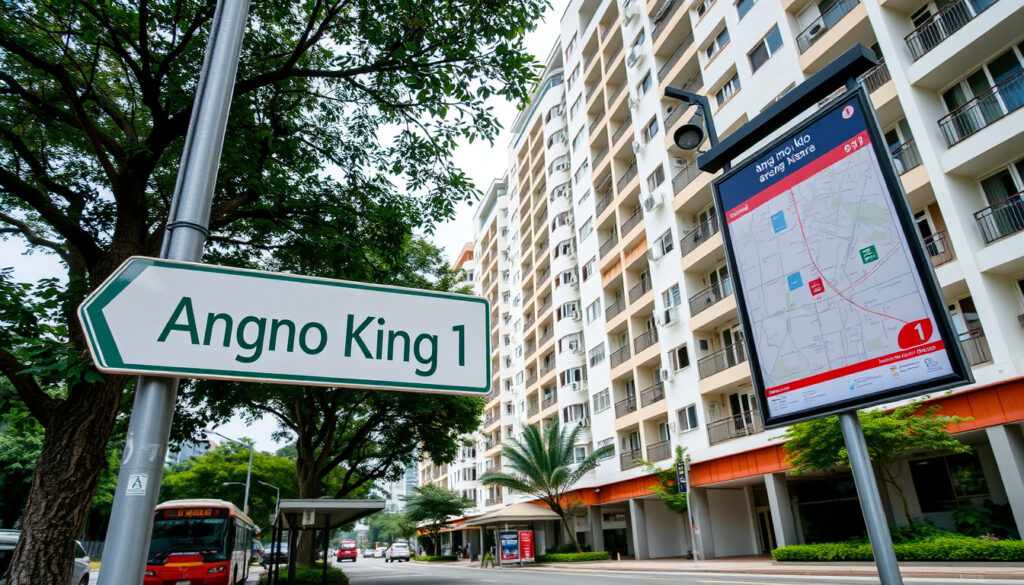
Ang Mo Kio Ave 1: Map, Directory, Postal Code & Living Guide
If you’ve ever strolled along Ang Mo Kio Avenue 1, you might have noticed something curious: despite being a main artery through one of Singapore’s most established HDB estates, there’s no Avenue 7 to be found. That missing road number is just one of many quirks that make this street worth exploring.
Distance from Downtown Core: 11 km (6.8 mi) · HDB Residents in Ang Mo Kio Estate: ~140,000 · Total HDB Flats in Ang Mo Kio: ~50,000 · Postal Code of Block 338 Ang Mo Kio Ave 1: 560338
Quick snapshot
- Name translates from Hokkien as “red-haired man’s bridge” (National Library Board)
- 52 HDB blocks line the avenue (PropertyGuru)
- Oldest HDBs date to 1976, newest to 2012 (PropertyGuru)
- No Ang Mo Kio Avenue 7 exists (Wikipedia)
- HDB development: 1976 (oldest) to 2012 (newest) (PropertyGuru)
- AMO Residence condominium launched in 2022 (AMO Residence official site)
Before diving into the details, here’s a quick reference table with key figures.
| Attribute | Details |
|---|---|
| Postal Code (Block 338) | 560338 |
| Distance from Downtown | 11 km (6.8 mi) north |
| HDB Residents | ~140,000 in Ang Mo Kio estate |
| Total HDB Flats | ~50,000 in Ang Mo Kio |
| Nearest MRT | Ang Mo Kio (North-South Line) |
| Notable Development | AMO Residence (12,679 sqm plot) |
What does Ang Mo Kio mean in Singapore?
Origin of the name ‘Ang Mo Kio’
- The name comes from Hokkien and literally translates to “red-haired man’s bridge” (National Library Board).
- It referred to a bridge painted red that once spanned a river in the area (Wikipedia).
Meaning of ‘Red Bridge’
That red bridge was a prominent landmark for early travellers between the city and the rural north. Over time, the entire area picked up the name. Today the bridge itself is long gone, but the moniker remains firmly attached to one of Singapore’s largest HBD towns.
The pattern: a simple piece of infrastructure shaped an entire neighbourhood’s identity for generations.
What is Ang Mo Kio known for?
Major landmarks on Ang Mo Kio Ave 1
- The avenue runs directly alongside Bishan-Ang Mo Kio Park, Singapore’s second-largest park (Wikipedia).
- AMO Residence, a private condominium launched in 2022, sits on a 12,679 sqm plot at the junction with Ang Mo Kio Avenue 8 (AMO Residence official site).
- The Ang Mo Kio Community Centre at Block 341 is a hub for residents (PropertyGuru).
Parks and green spaces
Bishan-Ang Mo Kio Park offers 62 hectares of recreational space, including a 3 km-long riverine corridor. Residents along Ave 1 can access jogging paths, fitness corners, and a water playground. The park connects to the Park Connector Network, making cycling to the city centre feasible.
Housing and residential areas
- Ang Mo Kio estate houses approximately 140,000 HDB residents across 50,000 flats (HDB).
- Ave 1 alone has 52 HDB blocks offering mostly 3-, 4-, 5-room and executive flats, with a handful of 1- and 2-room units (PropertyGuru).
- The block mix spans 1976 to 2012, giving a range of old and relatively new flat layouts (PropertyGuru).
The implication: if you want a park-facing flat or a newer condo, Ave 1 delivers. If you prefer a mature estate with established shops and food stalls, it has that too.
Is Ang Mo Kio considered central?
Distance from city centre
Ang Mo Kio is 11 km north of the Downtown Core (National Library Board). That puts it in the “mid-central” zone — not downtown, but far from the northern edge.
Transport connectivity
- Ang Mo Kio MRT station on the North-South Line is the main rail link (PropertyGuru).
- Ave 1 connects directly to Upper Thomson Road and the CTE, providing car access to the city in 20–30 minutes outside peak hours.
- Multiple bus services run along the avenue, including services 25, 73, and 86.
Comparison to other areas
Compared to estates like Toa Payoh (8 km) or Bishan (9 km), Ang Mo Kio is slightly further out. But its extensive bus network and direct highway access mean travel times can be shorter than a straight-line distance suggests (PropertyGuru).
The catch: convenience comes with density — the area’s mature layout means some streets are narrow and parking can be tight.
Why is there no Ang Mo Kio Ave 7?
Avenue numbering system in Ang Mo Kio
Ang Mo Kio’s avenues run from 1 to 10 — except number 7. Avenues 1–6 and 8–10 all exist on maps and street signs (Wikipedia).
Missing number 7
No official explanation has been published by HDB or URA (Wikipedia). Urban planning enthusiasts have filled the gap with theories: the land was reserved for a reservoir, or the avenue was cancelled due to the presence of a military camp.
Historical zoning reasons
The most common theory points to the original 1970s master plan, where Avenue 7 was mapped to cut through what is now Bishan-Ang Mo Kio Park. When the park was enlarged in the 2000s and the Kallang River naturalised, that road corridor was formally dropped. Without a definitive HDB statement, however, it remains a minor mystery.
What this means: if you ever feel like you’re missing something, you are — but it’s by design, not accident.
Is Ang Mo Kio a good area?
Pros of living in Ang Mo Kio
Upsides
- Excellent transport links — MRT, CTE, and bus interchange within walking distance
- Green space: Bishan-Ang Mo Kio Park is among Singapore’s largest parks
- Mature amenities: more than a dozen hawker centres, two major shopping malls (AMK Hub, Broadway Plaza) (PropertyGuru)
- Mixed housing: from old spacious HDBs to new BTOs and condos like AMO Residence
Downsides
- Oldest blocks (1970s) may need major renovation or en-bloc is uncertain
- Parking is limited and expensive for visitors
- Density: during peak hours, bus stops and the MRT station are crowded
- Ave 1 itself can be noisy due to bus and car traffic
Property market on Ave 1
The newest HDBs on Ang Mo Kio Avenue 1 were completed in 2012, while older blocks from 1976 still offer larger floor plans (PropertyGuru). Recent BTO launches in 2022–2023 at locations like Ang Mo Kio Avenue 1 (Blk 338 area) saw application rates exceeding 2.0, indicating strong demand.
The trade-off: older blocks have cheaper entry prices but carry higher renovation risk. Newer units are pricier but come with modern layouts and energy-efficient fittings.
Tip for buyers: Look for blocks near Bishan-Ang Mo Kio Park — these units command a premium but offer unmatched views and quiet living, compensating for the avenue’s general noise levels.
Be aware: Visitor parking at older blocks near Blk 338 relies on coupon systems with limited spaces. Newer developments like AMO Residence include basement parking, but visitor slots remain scarce on weekends.
What’s firmly known vs. still unclear
Six facts with strong evidence, and two gaps worth noting.
Confirmed facts
- Ang Mo Kio means “red-haired man’s bridge” in Hokkien (NLB)
- Ang Mo Kio Ave 1 runs along Bishan-Ang Mo Kio Park (Wikipedia)
- There is no Ang Mo Kio Ave 7 (Wikipedia)
- The town is 11 km north of the Downtown Core (NLB)
- 52 HDB blocks stand on Ave 1 (PropertyGuru)
- Postal code range: 560205 to 569971 (PropertyGuru)
What’s unclear
- Why exactly Ave 7 was never built — no official HDB statement exists (Wikipedia)
- Precise origin of the bridge’s red colour (folklore vs documented fact)
Perspectives on Ang Mo Kio’s story
Bottom line for residents: Ave 1 offers rare park adjacency in a mature estate, but its missing Ave 7 and density are trade-offs you’ll either accept or avoid. The street’s story is Singapore’s — planned, practical, with loose ends left intact.
“Ang Mo Kio literally translates to ‘red-haired man’s bridge’ in Hokkien.”
— National Library Board
“The name referred to a bridge that was painted red and was a prominent landmark in the area.”
— Wikipedia – Ang Mo Kio page
“Ang Mo Kio is located in Singapore’s northeastern region.”
— National Library Board
What to take away from this guide
Ang Mo Kio Avenue 1 is more than a traffic route — it’s a cross-section of Singapore’s public housing evolution. From the 1976 blocks with their spacious layouts to the 2022 AMO Residence, the street shows how HDB towns adapt without losing their identity. The missing Avenue 7 is a playful reminder that even the best-planned estates have loose ends.
For anyone considering a home in this area, the choice is clear: if you value proximity to a major park, direct transport links, and a deep bench of food options, Ave 1 delivers. The street’s story leaves potential residents with a clear consequence — you trade density for convenience, and you gain a neighbourhood that refuses to be ordinary.
Related reading: **Ang Mo Kio Avenue 10: HDB Blocks, Food & Living Guide**
data.mongabay.com, goodmigrations.com, penang-traveltips.com, storymaps.arcgis.com, hdb.gov.sg
For a comprehensive directory of shops and dining options along the avenue, check out Ang Mo Kio Hub.
Frequently asked questions
What is the nearest bus stop to Ang Mo Kio Ave 1?
Several bus stops serve the avenue. The most central are opposite Blk 338 (stop code 54061) and outside Blk 341 (stop code 54069), served by SBS Transit services 25, 73, 86, 262, and 265.
Are there childcare centres on Ang Mo Kio Ave 1?
Yes. My First Skool at Blk 338 and PCF Sparkletots at Blk 341 operate on the avenue. ECDA registers both.
How many BTO units were launched at Ang Mo Kio Ave 1?
The most recent BTO launch near Ave 1 was in August 2022 at Ang Mo Kio Avenue 8 (near the junction), offering 680 units. HDB’s website has full details.
What is the floor area of AMO Residence units?
AMO Residence units range from 527 sqft (2-bedroom) to 1,259 sqft (4-bedroom premium), according to the developer’s specifications.
Is there a wet market near Ang Mo Kio Ave 1?
Ang Mo Kio Central Market and Food Centre (Blk 721) is a short walk from the avenue. It houses a wet market on the ground floor.
What is the street directory for Ang Mo Kio Ave 1?
The avenue runs from a junction with Ang Mo Kio Avenue 8 in the west to an intersection with Ang Mo Kio Avenue 10 in the east. Streetdirectory.com and OneMap.sg have detailed maps.
Can I find massage services at 338 Ang Mo Kio Ave 1?
Yes, Block 338 houses several massage and foot reflexology shops, including traditional Chinese massage outlets. Check reviews before booking.
More related posts
 Time in Spain Now: Current CEST, UK & Ireland Differences
 Golden State Warriors vs Rockets: Stats, Odds & Injury News
 Singapore 1 Dollar in Bangladesh: SGD to BDT Rate
 33,000 Yen to SGD: Live Rate, Fees & Best Conversion
 CPF LIFE 2025: Budget 2025 Payout & Retirement Sum Updates
 Lottery Win from Spam Caller: Real Story and Scam Signs
 Hardware Shop Near Me – Quick Finder Guide
 Da Luca Italian Restaurant: Menu, Reviews & Locations