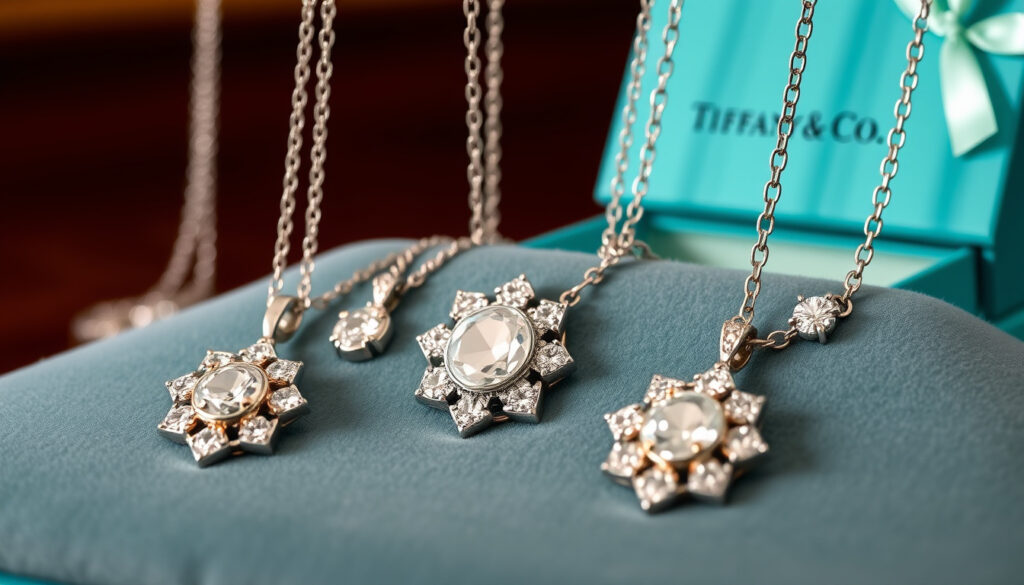
Tiffany & Co. Necklaces: Cost, Value & Authenticity
Few jewellery boxes feel complete without a Tiffany & Co. necklace — but that blue box often comes with a price tag that makes you pause, with sterling silver pendants starting around €150 and diamond pieces passing €100,000. This guide explains what you’re really paying for, how to spot fakes, and how Tiffany measures up against Cartier — all tailored for Irish shoppers who want honest answers.
Founded: 1837 ·
Founder: Charles Lewis Tiffany ·
Price range: $150 – $500,000+ ·
Famous for: Return to Tiffany™ collection ·
Parent company: LVMH (since 2021) ·
Global stores: 300+
Quick snapshot
- Entry-level sterling silver pendants from €150 (Tiffany & Co. official site)
- High-jewellery diamond necklaces over €100,000 (Tiffany & Co. official site)
- Resale value typically holds 50–70% of retail (Gray & Sons (pre-owned jewellery specialist))
- Look for “Tiffany & Co.” engraving and metal stamps (Suttons and Robertsons (jewellery authentication guide))
- Real pieces use 925 sterling silver, 18k gold, or platinum (Suttons and Robertsons (jewellery authentication guide))
- Purchase only from official stores or authorised retailers (Suttons and Robertsons (jewellery authentication guide))
- Cartier generally 30–50% more expensive at entry level (S&R Jewellers (luxury brand comparison))
- Both offer iconic designs but different brand heritage (S&R Jewellers (luxury brand comparison))
- Tiffany perceived as more accessible luxury (S&R Jewellers (luxury brand comparison))
- Return to Tiffany heart tag remains best-seller (Tiffany & Co. product pages)
- Chunky silver chains gaining popularity (Tiffany & Co. product pages)
- Layered necklaces with personalised pendants (Tiffany & Co. product pages)
Six facts at a glance — from its New York roots to the hallmark that confirms authenticity.
| Label | Value |
|---|---|
| Founding year | 1837 |
| Headquarters | New York City, USA |
| Iconic necklace collection | Return to Tiffany™ |
| Price of best-selling silver heart tag | €195 (Ireland, as of 2025) |
| Parent company | LVMH Moët Hennessy Louis Vuitton |
| Authentication hallmark | Tiffany & Co. 925 (for silver) |
How much does a Tiffany and Co necklace cost?
Prices span a huge range. The most affordable entry point is the Return to Tiffany sterling silver heart tag pendant at roughly €195 in Ireland — a piece that has become the brand’s signature. At the other end, high-jewellery diamond necklaces from the Schlumberger or Jean Schlumberger collections can exceed €100,000.
Why is Tiffany’s so expensive?
Three factors drive the cost. Materials: genuine Tiffany necklaces use 925 sterling silver, 18k gold (stamped 750), or platinum (stamped 950) (Suttons and Robertsons (authentication guide)). Craftsmanship: each piece is hand-finished in the brand’s Rhode Island workshop, with soldered, continuous links that show no visible join line (Suttons and Robertsons). Brand prestige: the blue box, the Fifth Avenue flagship, and over 180 years of heritage command a premium. The packaging alone is a marketing asset.
- Entry-level silver pendant: €150–€300
- 18k gold pendant: €800–€3,000
- Diamond-set necklace: €5,000–€100,000+
Is it worth it to buy a Tiffany and Co necklace?
From a value-retention perspective, Tiffany necklaces hold roughly 50–70% of their retail price on the pre-owned market, according to Gray & Sons (pre-owned luxury dealer). That’s stronger than many fashion brands but below the near-full retention of high-jewellery pieces from Cartier or Van Cleef & Arpels. The catch: common silver pieces depreciate more than limited-edition or signature designer items.
You pay a 40–60% brand premium versus unbranded equivalents. The upside: Tiffany’s authentication system and global warranty make resale easier. Irish buyers should note that second-hand prices on platforms like The RealReal often track 50–65% of original retail.
The pattern: Tiffany pricing reflects a calculated layering of material, craftsmanship, and brand equity, with clear trade-offs for the buyer.
Is Cartier or Tiffany more expensive?
Cartier consistently sits 30–50% above Tiffany at comparable entry levels, according to S&R Jewellers (luxury comparison). A Cartier Love bracelet costs about €6,500 in yellow gold; a Tiffany HardWear link bracelet in similar gold runs around €4,200. For necklaces specifically, a Cartier Panthère pendant starts at roughly €1,600, while Tiffany’s Return to Heart gold pendant is about €950.
Which is better, Cartier or Tiffany?
“Better” depends on intent. Cartier leans slightly more understated and formal; Tiffany is perceived as more accessible and playful (S&R Jewellers). Both use real gold and quality stones. The decision often comes down to design preference and brand identity. For Irish shoppers, Tiffany’s new Grafton Street flagship in Dublin makes browsing easier — Cartier has a boutique on Brown Thomas but limited standalone stock.
Three differences, one pattern: Cartier charges for exclusivity, Tiffany for recognisability.
| Dimension | Tiffany & Co. | Cartier |
|---|---|---|
| Entry-level necklace price | €150 (silver) | €600+ (gold only) |
| Signature necklace style | Return to Tiffany heart tag | Panthère pendant |
| Brand perception | Accessible luxury, youthful | Understated, formal |
| Resale value (typical % of retail) | 50–70% | 60–80% |
| Dublin store presence | Flagship on Grafton Street | Brown Thomas concession |
If you want a statement piece that everyone recognises, go Tiffany. If you prefer discreet status, Cartier wins. For Irish buyers on a budget, the Tiffany silver heart tag delivers the brand experience at one-fifth the cost of Cartier’s cheapest necklace.
What this means: the choice between Tiffany and Cartier is less about quality and more about the statement you want to make.
How do I tell if a Tiffany necklace is real?
Authenticating a Tiffany necklace is easier than you think. Start with the hallmarks. Real Tiffany silver is stamped “925” and “Tiffany & Co.” in crisp, centred letters (Gray & Sons (expert authentication guide)). 18k gold pieces bear “750”. The font should be clean — fakes often have blurry or uneven engravings (Suttons and Robertsons).
Spotting fake Tiffany – key signs
- Weight: fakes feel significantly lighter because they use cheaper alloys (Suttons and Robertsons).
- Chain links: genuine chains have soldered, continuous links with no visible join line. Counterfeits show linking marks or seams (Suttons and Robertsons (authentication detail)).
- Engravings: fake stamps are often shallow, misaligned, or read “Tiffany & Co.” with lowercase letters (The RealReal (luxury consignment authenticator)).
- Packaging: genuine Tiffany blue boxes have a specific Pantone colour (1837 blue) and crisp white ribbon; fakes use cheap cardboard and dull ribbon.
Even experienced dealers can be fooled by high-end replicas. For a definitive answer, send the piece to Tiffany’s official restoration service — they will authenticate for free before quoting any repairs.
The implication: never buy a second-hand Tiffany necklace without examining the hallmarks in person. Irish buyers should visit the Grafton Street store to compare weight and engraving precision against an authentic piece.
Is Tiffany owned by Louis Vuitton?
Yes. In January 2021, LVMH Moët Hennessy Louis Vuitton completed its $15.8 billion acquisition of Tiffany & Co. (Wikipedia (historical overview)).
History of Tiffany ownership
The brand was founded in 1837 by Charles Lewis Tiffany and John B. Young in New York City. It remained an independent company until 2021, with a brief public listing on the NYSE. LVMH acquired it to strengthen its jewellery division, placing it alongside Bulgari and Chaumet.
- 1837–2021: Independent, family-led ownership
- 2021–present: Subsidiary of LVMH, the world’s largest luxury group
What this means: since the acquisition, Tiffany has accelerated store renovations (including Dublin’s Grafton Street flagship) and increased digital marketing. Product quality and materials remain the same — LVMH is protective of the brand’s heritage.
What is the necklace trend right now?
The Return to Tiffany heart tag is still the reigning best-seller in 2025 (Tiffany official product page). But chunky silver chains, multi-layered necklaces, and personalised pendants with initials are gaining momentum, driven by celebrity styling and social media.
Current popular Tiffany necklace styles
- Return to Tiffany heart tag — remains the most recognised piece, worn alone or layered.
- HardWear link chain — oversized, industrial look in silver or gold.
- Elsa Peretti Bean pendant — minimalist, organic shape, popular for stacking.
- Bone cuff-inspired necklace — a recent revival from the 1970s archives.
For Irish shoppers, the trend leans toward versatility: a single classic piece that works day-to-evening. The heart tag fits that bill. If you want to follow the chunky chain wave, the HardWear collection offers a modern twist without screaming “logo”.
Trend-driven buyers tend to lose resale value faster. The heart tag’s staying power means it retains 60% of retail after five years, while fashion-forward pieces drop to 30–40%. Invest in the icon, not the hype.
The catch: trends fade, so investing in iconic pieces offers better long-term value.
How do Tiffany and Cartier compare? (Step-by-step decision guide)
If you’re torn between the two, here’s a practical framework for choosing.
- Set your budget. Under €500? Only Tiffany offers silver necklaces. Cartier starts above €600.
- Decide your style. Love the iconic heart tag? Tiffany. Prefer a panther motif or understated logo? Cartier.
- Check resale potential. Cartier holds 10–15% more value on average, but iconic Tiffany pieces (e.g., Schlumberger designs) can exceed Cartier returns.
- Test in person. Visit Tiffany’s Grafton Street flagship, then Cartier’s Brown Thomas counter. Feel the weight, see the finish, try both.
- Consider servicing. Tiffany offers free cleaning and polishing for life; Cartier charges for services after two years.
The trade-off: Tiffany wins on accessibility and service, Cartier on exclusivity and long-term value.
- Instantly recognisable brand with iconic designs
- Entry-level pricing accessible to more shoppers
- Free cleaning and polishing for life
- Solid resale value for signature pieces
- 40–60% brand premium over unbranded equivalents
- Silver pieces require regular maintenance
- Common designs depreciate faster than limited editions
- Repairs are chargeable and can be costly
Timeline: Key moments in Tiffany & Co. history
From a small New York shop to a global luxury powerhouse under LVMH.
– Tiffany & Co. founded by Charles Lewis Tiffany and John B. Young in New York (Wikipedia (historical overview)).
– Introduction of the Tiffany® Setting engagement ring, revolutionising the diamond ring market (Wikipedia).
– Launch of the Return to Tiffany keyring, later adapted to necklaces (Tiffany official history).
– Acquired by LVMH for $15.8 billion (LVMH (parent company announcement)).
– Tiffany opens new flagship store on Grafton Street, Dublin.
What’s confirmed and what’s still unclear
- Tiffany & Co. was founded in 1837 (Wikipedia).
- The company was acquired by LVMH in January 2021 (LVMH).
- Return to Tiffany heart tag is a best-selling necklace (Tiffany official site).
- Authentic Tiffany silver is stamped “925” or “Sterling” (Suttons and Robertsons).
- Exact production cost of individual pieces is not public.
- Resale value varies greatly by model and condition.
- Future trends may shift depending on fashion cycles.
- Pricing for specific collections may differ between US and Irish markets.
What buyers are saying: Quotes from experts and enthusiasts
“Tiffany & Co. was founded in 1837 by Charles Lewis Tiffany and John B. Young in New York City, and became a global luxury brand with a reputation for exceptional craftsmanship.”
— Wikipedia (encyclopaedic overview)
“Authentic Tiffany chains have soldered, continuous links with no visible join line. Fakes often show linking marks or rough seams.”
— Suttons and Robertsons (jewellery authentication experts)
“Tiffany jewellery is commonly marked with the brand name plus a metal purity stamp – 925 for silver, 750 for 18k gold. These should be sharp and centred.”
— Gray & Sons (pre-owned jewellery authenticator)
Summary
Tiffany & Co. necklaces sit firmly in the affordable-luxury space, backed by more than 180 years of craftsmanship and a fiercely protected brand image. For Irish shoppers, the choice between a heart tag pendant and a Cartier alternative comes down to budget and taste. The clear verdict: if you want an iconic, instantly recognisable piece that you can wear daily and resell at 50–70% of retail, the Return to Tiffany heart tag is your best bet. For those seeking exclusivity and higher resale, Cartier merits the extra spend. Irish shoppers can compare both brands directly in Dublin, ensuring their chosen piece matches expectations for weight, finish, and fit before committing.
For a deeper look at how these pieces hold their worth over time, refer to this Tiffany & Co. necklace value guide that breaks down care and resale considerations.
Frequently asked questions
Are Tiffany necklaces made of real silver?
Yes, silver Tiffany necklaces are made from 925 sterling silver, stamped with “925” and “Tiffany & Co.” (Suttons and Robertsons).
Does Tiffany offer a lifetime warranty?
Tiffany does not have a formal lifetime warranty, but it offers free cleaning and polishing for life. Repairs are chargeable (Tiffany official care policy).
What is the most affordable Tiffany necklace?
The Return to Tiffany sterling silver heart tag pendant, currently €195 in Ireland, is the cheapest entry point.
How to style a Tiffany necklace?
Layer the heart tag with other gold or silver chains of different lengths. For a minimalist look, wear it alone on a fine chain.
Can I buy Tiffany necklaces online in Ireland?
Yes, you can purchase directly from tiffany.com with delivery to Ireland. The Grafton Street store also offers click-and-collect.
Is Tiffany sterling silver hypoallergenic?
Yes, 925 sterling silver is generally hypoallergenic. However, some people react to the 7.5% copper content. Try a sample piece before committing.
Do Tiffany necklaces come with a certificate of authenticity?
New purchases from Tiffany or authorised retailers come with a Tiffany & Co. branded box and care card, but not a separate certificate. The hallmark on the piece itself is the primary authentication.
Related reading
- Pure Gold Price Singapore: 999 & 916 Rates Per Gram — understanding metal hallmarks
- Lazy Sunday Morning Perfume: Notes, Review & Longevity — luxury lifestyle roundup
More related posts
 Best Books for Personal Growth – Top Expert Recommendations
 Vibrant Group Share Price: Live SGX:BIP Quote & News
 Far East Flora Clementi: Hours, Cafe, Parking & Directions
 Where to Vote 2025: Irish Presidential Election Guide
 Marina Bay Financial Centre: Tenants, Ownership & Facts
 How Many Weeks in a Year? 52 or 56? 53-Week Years Explained
 Credit Cards with Lounge Access: Top Picks & Guide
 Citi Wealth First Account: 7.51% Interest & Bonuses