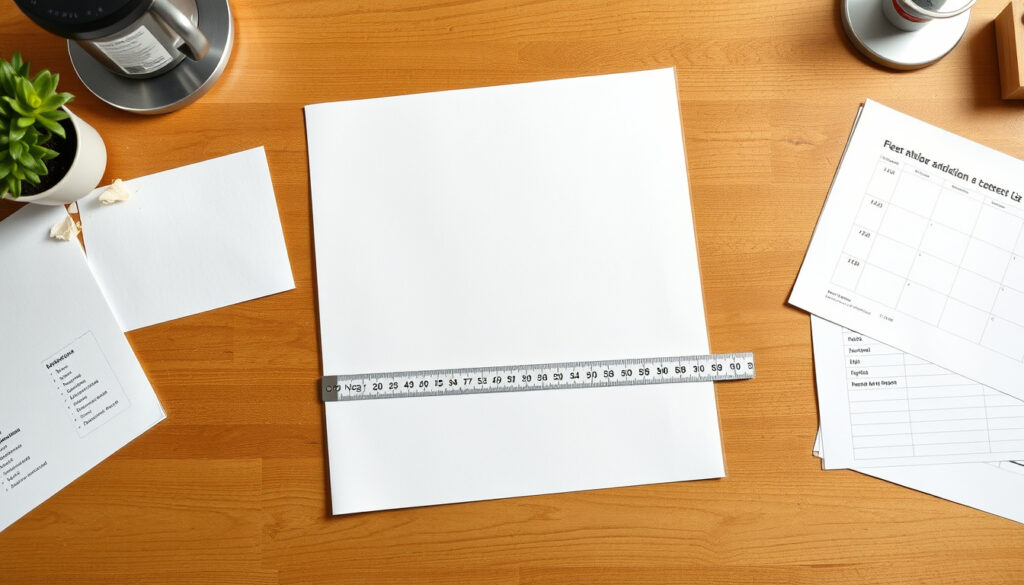
A3 Paper Size in CM: Dimensions, Comparisons & Chart
A3 paper measures exactly 29.7 cm × 42.0 cm, according to ISO 216—the international standard that governs paper sizes for most of the world. This specific dimension, roughly 11.7 × 16.5 inches, sits between standard office paper and large-format prints, making A3 the preferred size for detailed reports, architectural drawings, and professional presentations that need more visual space than A4 permits.
A3 Width: 29.7 cm · A3 Height: 42 cm · A3 Area: 0.125 m² · A3 in Inches: 11.7 × 16.5 in · ISO Standard: ISO 216
Quick snapshot
- A3 measures exactly 29.7 × 42.0 cm (Dimensions.com)
- ISO 216 specifies tolerances of ±2 mm for sizes in the 150–600 mm range (PaperSizes.org)
- Regional adoption rates and legal mandates by country
- Pixel dimensions verified across more DPI standards beyond 300 DPI
- German DIN 476 standard developed in the 1920s–1930s as the basis (A2-Size.com)
- ISO 216 adopted internationally in 1975 (Wikipedia)
- A3 Plus (Super A3) introduced as a non-ISO variant in the 1990s (PaperSizes.org)
- ISO 217 and ISO 269 remain supplementary standards for envelope and raw paper sizes (PaperSizes.org)
| Property | Value |
|---|---|
| Width | 29.7 cm |
| Height | 42 cm |
| MM Equivalent | 297 × 420 mm |
| Inches | 11.7 × 16.5 in |
| Surface Area | 0.125 m² |
What is the A3 size in cm?
Exact dimensions
The official ISO 216 standard defines an A3 sheet as exactly 29.7 centimeters wide by 42.0 centimeters high. In millimeters, those dimensions translate to 297 mm × 420 mm—measurements that print designers and commercial shops work with daily. The surface area of a single A3 sheet comes to 0.125 square meters, which happens to be exactly one-eighth of the A0 base size that anchors the entire A-series hierarchy.
“The official ISO 216 standard for an A3 sheet of paper is exactly 29.7 centimetres wide by 42.0 centimetres high.” — Virtuall Blog, Design Blog
In mm and inches
For those working across measurement systems, A3 converts to 11.69 × 16.54 inches. Professional printing applications typically round this to 11.7 × 16.5 inches for practical use. At standard 300 DPI resolution, an A3 image requires 1754 × 2480 pixels for proper reproduction. The ISO 216 standard (Encyclopedia) allows manufacturing tolerances of ±2 mm for paper in the 150–600 mm dimension range.
When you order custom mats or mounts for A3 artwork, a 0.3 cm discrepancy between your frame and your paper becomes visible—and frames aren’t cheap. Commercial printers expect files at exact A3 dimensions because scaling even slightly can introduce unwanted borders or force awkward crops.
Is 30x40cm A3?
Dimension comparison
A 30 × 40 cm sheet is close to A3 but not identical. True A3 is 29.7 × 42.0 cm, meaning the “30 × 40 cm” approximation undershoots width by 3 mm and overshoots height by 2 cm. For most casual purposes, 30 × 40 cm feels close enough, but in professional printing or precision framing, that gap becomes problematic. The Dimensions.com reference confirms these exact ISO 216 measurements.
Framing compatibility
Will an A3 sheet fit inside a 30 × 40 cm frame? The short answer: barely, and only with trimming or careful positioning. Since A3 is taller than it is wide (42 cm versus 29.7 cm), it won’t fit the 40 cm height comfortably within a frame meant for 30 × 40 cm oriented the other way. For proper A3 framing, you need at minimum a 30 × 42 cm opening, though 30 × 45 cm frames provide breathing room for mats.
“ISO 216 is an international standard for paper sizes, used around the world except in North America and parts of Latin America.” — Wikipedia, Encyclopedia
Many mass-market frames marketed as “A3 size” actually measure 30 × 40 cm internally—a deliberate shortcut that catches buyers off guard. Read the actual dimensions before purchasing, not just the label.
Which is bigger, an A3 or an A4?
A3 vs A4 sizes
A3 is significantly larger than A4—exactly twice the area, in fact. While A3 measures 297 × 420 mm, A4 comes in at 210 × 297 mm, making it precisely half the dimensions when folded. This relationship isn’t accidental: the ColorCopiesUSA printing guide explains that ISO 216’s √2 aspect ratio means every A-size folds perfectly into the next smaller one. Two A4 sheets placed side by side equal one A3 with no wasted paper or odd margins.
“The ISO 216 standard uses the √2 (1.414) aspect ratio, which means when you fold any size in half, you get the next smaller size with the same proportions.” — ColorCopiesUSA, Printing Guide
Practical differences
In everyday terms, A4 is the standard office and printer paper size most of the world uses for documents, letters, and homework. A3 sits in a different category—it’s the size of broadsheet newspaper pages, detailed architectural drawings, and professional design presentations. The Wikipedia overview notes that A4 is the most commonly available paper size worldwide, while A3 typically requires special ordering or dedicated large-format copiers.
If your office printer handles A3, you can fold any A4 document in half and it will fit perfectly into a C4 envelope—a handy feature for mailing larger reports without oversize postage.
What is A1, A2, A3, and A4?
A series overview
The A-series defined by Pixartprinting (Commercial print vendor) follows a simple mathematical logic: A0 defines the starting point at exactly 1 square meter, and every subsequent number halves the area. A1 is 59.4 × 84.1 cm, A2 is 42 × 59.4 cm, A3 is 29.7 × 42 cm, and A4 is 21 × 29.7 cm. The series continues down through A5 (14.8 × 21 cm) and beyond, though smaller sizes see diminishing practical use.
Size progression
The ANSI Blog (Standards organization) confirms that A4 is half of A3, and A3 is half of A2. This halving property means that an A2 sheet, when cut exactly in half along its longer edge, produces two A3 sheets with identical proportions. The aspect ratio stays constant at 1:√2 (approximately 1:1.414) because the √2 ratio has the unique property of remaining unchanged when a rectangle is halved along its longer side.
The table below shows how the A-series sizes relate through the halving property that defines ISO 216.
| Size | Dimensions (cm) | Dimensions (mm) | Area (m²) |
|---|---|---|---|
| A0 | 84.1 × 118.9 | 841 × 1189 | 1.000 |
| A1 | 59.4 × 84.1 | 594 × 841 | 0.500 |
| A2 | 42.0 × 59.4 | 420 × 594 | 0.250 |
| A3 | 29.7 × 42.0 | 297 × 420 | 0.125 |
| A4 | 21.0 × 29.7 | 210 × 297 | 0.063 |
| A5 | 14.8 × 21.0 | 148 × 210 | 0.031 |
What this means: each step down the A-series halves the surface area while maintaining the √2 aspect ratio that keeps proportions consistent across all sizes.
What’s bigger, A1, A2, A3, A4, and A5?
Full A series ranking
The hierarchy runs clearly from largest to smallest: A1 exceeds A2, A2 exceeds A3, A3 exceeds A4, and A4 exceeds A5. The Neenah Paper resource (Paper manufacturer) provides the full A-series table showing A1 at 59.4 × 84.1 cm, A2 at 42 × 59.4 cm, A3 at 29.7 × 42 cm, and A5 at 14.8 × 21 cm. The area halves with each step down the series, making size comparisons straightforward.
Common uses
Each A-series size serves distinct practical purposes. A1 and A0 dominate technical drawings, engineering blueprints, and large format posters. A2 handles small posters and detailed art prints. A3—your target size—covers magazines, professional reports, and presentations that need more visual space than A4 permits. A4 handles everyday documents, while A5 suits notebooks, flyers, and promotional postcards. The Virtuall Blog (Design resource) notes that A3’s printing standard status makes it essential for anyone producing materials for international distribution.
Related reading: standard size charts
A3 measures precisely 29.7 by 42 cm under ISO 216 standards, where detailed A3 cm comparisonsdelve into side-by-side charts with A4, A2, and inches equivalents.
Frequently asked questions
What size is an A3 photo?
An A3 photo measures 29.7 × 42.0 cm (297 × 420 mm or 11.7 × 16.5 inches). At 300 DPI resolution, this translates to image dimensions of 1754 × 2480 pixels. A3 photos require specific print settings and cannot be printed on standard home printers without scaling or tiling.
Is A3 medium or large?
A3 falls between medium and large in the A-series. It’s larger than A4 (standard office paper) but smaller than A2 (small poster size). For general printing purposes, A3 is considered large format compared to everyday documents, though it’s mid-range when compared to the full A-series including A1 and A0.
Which paper size is 30×40?
The 30 × 40 cm size is not a standard ISO 216 dimension. It’s a common commercial frame and matting size that approximates A3 but doesn’t match it exactly. True A3 is 29.7 × 42.0 cm, so 30 × 40 cm is slightly narrower and shorter. When purchasing frames or mats, always specify actual dimensions rather than assuming approximate labels.
What is A3 size in inches?
A3 measures 11.69 × 16.54 inches when converted precisely, though many sources round this to 11.7 × 16.5 inches for practical use. The PaperSizesWiki (Paper sizes reference) provides this inch conversion alongside the metric specifications.
What is A3 size in mm?
A3 is 297 × 420 mm. This measurement, confirmed by Dimensions.com (Specifications database), forms the basis for all A-series paper manufacturing worldwide and determines how many A3 sheets can fit on standard printing presses and cutting machines.
What is A2 size in cm?
A2 measures 42.0 × 59.4 cm (420 × 594 mm). It is exactly twice the area of A3 and serves as the next size up in the A-series. A2 is commonly used for small posters, art prints, and technical drawings.
What is A5 size in cm?
A5 measures 14.8 × 21.0 cm (148 × 210 mm). It is exactly half the area of A4 and one-quarter of A3. A5 is the standard size for notebooks, invitations, and flyers in countries using ISO 216 paper sizes.
What is A3 size in feet?
A3 measures approximately 0.974 × 1.378 feet (or more precisely, 0.973 × 1.378 feet). For most practical purposes, designers work in centimeters, millimeters, or inches rather than feet, since the metric and imperial inch conversions align more naturally with the √2 aspect ratio.
More related posts
 How Many Weeks in a Year? 52 or 56? 53-Week Years Explained
 Where to Vote 2025: Irish Presidential Election Guide
 Be t Digital Marketing Agency: How to Choo e in 2025
 Critical Illness Policy Coverage: What It Covers and How It Works
 Tung Tung Tung Sahur Meaning: Meme Origin & Explained
 Slot Gacor Royal138: Verified Facts & Analysis
 DBS Credit Card Annual Fee Waiver: How to Get it Waived
 Cé La Vi Singapore Photos: Menu, Spend & Dress Code