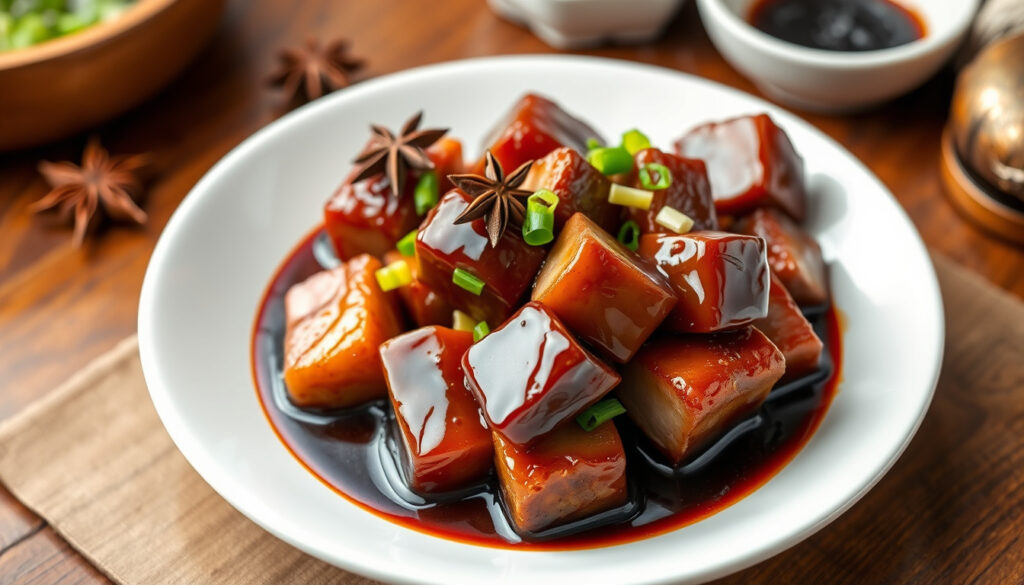
Braised Pork Belly Recipe: Step-by-Step Hong Shao Rou Guide
There’s something magical about a piece of pork belly that’s been slowly braised until it’s so tender it practically melts on your tongue. The deep mahogany glaze, the balance of salty and sweet, the layers of fat and meat that yield to a gentle fork — this is the promise of a proper braised pork belly, and especially of the Chinese classic hong shao rou. In this guide, you’ll learn the step-by-step method, the science behind each technique, common pitfalls to avoid, and a handy flavor ratio known as the “6‑2‑2 rule.” By the end, you’ll be able to produce a restaurant-quality dish right in your own kitchen.
Prep time: 20 minutes ·
Cook time: 2 hours ·
Total time: 2 hours 20 minutes ·
Servings: 4‑6 ·
Calories per serving: ~500 ·
Difficulty: Medium
Quick snapshot
- Blanching pork belly before braising improves clarity and texture (Caroline’s Cooking, food blog)
- Low and slow cooking is essential for tenderizing collagen (The Mini Chef, cooking blog)
- The 6‑2‑2 ratio (liquid:soy sauce:sugar) is a common guideline for Chinese braising liquid (Caroline’s Cooking, food blog)
- Whether to start blanching in cold or boiling water depends on the recipe (Red House Spice, Chinese recipe site)
- Optimal resting time after braising is debated among home cooks (Red House Spice, Chinese recipe site)
- Exact caramelization temperature for best color is recipe‑dependent (Red House Spice, Chinese recipe site)
- Simmer until fork‑tender: 1.5–2 hours (The Mini Chef, cooking blog)
- Some recipes need up to 3 hours (Betty Liu, personal recipe blog)
- The Woks of Life video simmers for 45 min to 1 hour before reduction (YouTube – The Woks of Life)
- Reduce the sauce uncovered until it becomes glossy and thick enough to coat the pork (Caroline’s Cooking, food blog)
- Serve over steamed rice or with steamed buns (Caroline’s Cooking, food blog)
- Store leftovers in the refrigerator up to 3 days or freeze (Caroline’s Cooking, food blog)
Here’s a quick overview of the key facts that define this classic dish.
| Fact | Detail |
|---|---|
| Origin | Shanghai‑style red braised pork (hong shao rou) |
| Cooking time | 2–2.5 hours total |
| Key flavor profile | Salty, sweet, umami, aromatic |
| Traditional serving | Over steamed rice or with steamed buns |
How do you braise pork belly?
Braising is a two‑stage process: first you brown the meat to build flavor, then you simmer it gently in a seasoned liquid until it’s fork‑tender. For Chinese‑style braised pork belly, that liquid typically includes soy sauce, rice wine, sugar, and aromatics like ginger, scallions, and star anise (The Mini Chef, cooking blog). The result is a dish that is both intensely savory and subtly sweet.
Prepare the pork belly
- Cut the pork belly into roughly 1‑inch (2.5 cm) cubes (Caroline’s Cooking, food blog).
- Blanch the pieces in boiling water for about 3 minutes. This step removes impurities and excess fat, giving the final dish a cleaner taste and better texture. (Caroline’s Cooking, food blog).
- Drain and rinse the pork under cold water, then pat dry.
Sear the meat
- Heat a wok or heavy pot over medium heat and add a little oil.
- Working in batches if needed, sear the pork cubes until they are golden brown on all sides. Overcrowding the pan will steam rather than brown the meat.
- Remove the pork and set aside.
Caramelize the sugar
- In the same pot, add a small amount of oil and about 2 tablespoons of rock sugar (or brown sugar). Let it melt over medium heat until it turns a dark amber or light caramel color. This caramelized sugar base is a defining technique in many hong shao rou recipes (The Mini Chef, cooking blog).
- Return the pork to the pot and stir to coat each piece in the caramel. This step deepens the color and adds complexity. (The Mini Chef, cooking blog).
Add braising liquid
- Pour in Shaoxing wine (about ¼ cup) to deglaze, scraping up any browned bits.
- Add light soy sauce and dark soy sauce — about 2 tablespoons each. The light soy provides saltiness, the dark soy adds color and a hint of sweetness. (Caroline’s Cooking, food blog).
- Add enough water or stock to nearly cover the pork, and toss in ginger slices, scallion pieces, and star anise.
Simmer until tender
- Bring the liquid to a gentle simmer, then cover and cook over medium‑low heat for about 1.5 to 2 hours. Stir every 30 minutes and check tenderness with a chopstick or fork. The pork is done when it yields easily. (The Mini Chef, cooking blog).
- For a more traditional home style, some cooks let it braise for at least 3 hours (Betty Liu, personal recipe blog), while a quicker version from The Woks of Life simmers for 45 minutes to 1 hour before reducing (YouTube – The Woks of Life). Adjust timing to your schedule but aim for at least 1.5 hours for proper collagen breakdown.
- When the meat is tender, remove the lid and increase the heat to reduce the sauce until it’s glossy and thick enough to coat the pork. This final reduction concentrates the flavors and gives the dish its signature sheen. (Caroline’s Cooking, food blog).
The caramelization step isn’t just for color — it builds a layer of flavor that can’t be achieved by adding sugar alone. Home cooks who skip it miss the deep, almost smoky sweetness that defines restaurant‑quality hong shao rou.
What is the secret to tender braised pork?
Tenderness in braised pork belly comes down to three things: temperature, chemistry, and patience. Collagen, the tough connective tissue in the meat, requires sustained heat to break down into gelatin. The process begins at around 160°F (71°C) and continues slowly over time (The Mini Chef, cooking blog). That is why low and slow cooking is non‑negotiable.
Low and slow cooking
- Maintain a gentle simmer, not a rolling boil. Bubbles should barely break the surface.
- At 180‑190°F (82‑88°C) internal pot temperature, collagen converts to gelatin efficiently without drying out the meat.
- A heavy‑bottomed pot or Dutch oven distributes heat evenly and prevents scorching.
Acid and sugar balance
- Shaoxing wine (rice wine) adds a mild acidity that helps tenderize the meat and balances the richness. This acidity complements the sweetness from the caramelized sugar, creating a layered taste. (Red House Spice, Chinese recipe site).
- Rock sugar (or brown sugar) contributes not just sweetness but also a glossy sheen when reduced. The Maillard reaction from caramelization adds depth.
Resting after cooking
- Let the braised pork rest for 10‑15 minutes after removing from heat. This allows the gelatin to set slightly, making the meat even more tender.
- Some recipes recommend refrigerating overnight and reheating the next day — the flavor deepens as it sits.
Braising longer (up to 3 hours) gives you fall‑apart tenderness but can cause the meat to lose its shape if overcooked. The 1.5‑hour mark offers the sweet spot: tender yet sliceable cubes that hold up to the sauce.
The pattern: Every tenderness technique — low heat, acid, and resting — works together to transform tough belly into silky, succulent meat. Neglect any one of them and the result will be chewy or dry.
Why boil pork belly before braising?
Blanching (boiling briefly) the pork belly before braising might seem like an unnecessary step, but it serves three critical purposes. Many Chinese recipes insist on it, and for good reason.
Removes impurities
- Parboiling draws out blood, scum, and other impurities that would otherwise cloud the braising liquid and create an off‑flavor. The water becomes foamy; after discarding it, the pork is cleaner. (Caroline’s Cooking, food blog).
- This is why many recipes start with cold water and bring it to a boil — the gradual heat release allows more impurities to escape. However, some cooks add the pork directly to boiling water, which also works. (Red House Spice, Chinese recipe site).
Reduces excess fat
- Blanching renders out some of the subcutaneous fat, preventing the final dish from being greasy. The fat that remains is more evenly distributed and less overwhelming.
- After blanching, rinse the pork under cold water to stop cooking and remove any loose fat particles.
Improves texture
- The brief heat firms the meat surface, helping the cubes keep their shape during the long braise. Without this step, the pork may fall into shreds.
- Blanching also tightens the skin (if left on), which adds a pleasant chewiness to the final dish.
Why this matters: Skipping the blanch leads to a murky, greasy sauce and softer, less defined meat cubes. The extra 5‑10 minutes at the start pay off in clarity and texture.
What are some common mistakes when braising pork belly?
Even experienced cooks can stumble on a few pitfalls when making braised pork belly. Here are the most frequent errors and how to avoid them.
Skipping the blanching step
- As discussed, this step is essential for a clean, non‑greasy result. Many beginners omit it to save time, but the difference is noticeable. (Caroline’s Cooking, food blog).
Overcrowding the pan during searing
- When too many pieces are in the pan at once, they steam instead of brown. Proper browning requires space between cubes so moisture can evaporate.
- Work in batches if necessary — the extra minute is worth it for deep caramelization.
Not skimming fat during simmering
- As the pork braises, rendered fat rises to the surface. If not skimmed occasionally, the sauce becomes greasy and heavy.
- Use a spoon or ladle to remove the fat every 30 minutes. Alternatively, refrigerate the finished dish overnight and lift off the solidified fat before reheating.
Using low‑quality soy sauce
- Cheap soy sauces are often thin and harsh. For hong shao rou, use a reputable brand of light soy sauce (such as Pearl River Bridge or Lee Kum Kee) for salinity, and a dark soy sauce (like Mushroom Dark Soy) for color and a subtle sweetness. (Caroline’s Cooking, food blog).
The most common mistake is impatience. Home cooks often cut the braise short because the meat looks done on the outside, but the interior collagen hasn’t fully converted. A chopstick test at 1.5 hours will confirm: if it slides in with little resistance, it’s ready; if not, give it another 15‑20 minutes.
What is the 6 2 2 pork rule?
The “6‑2‑2 rule” is a handy ratio used by many Chinese home cooks to create a balanced braising liquid without measuring each ingredient precisely. The numbers refer to parts by volume, usually tablespoons or cups, depending on the amount of meat.
Origin of the rule
- The ratio 6:2:2 stands for 6 parts liquid (water or stock), 2 parts soy sauce, and 2 parts sugar (by volume). It provides a consistently salty‑sweet base that works well for most pork belly braises. (Caroline’s Cooking, food blog).
- The rule is particularly associated with Shanghai‑style hong shao rou, where the sauce is meant to be rich and slightly sweet.
How to apply it
- For 500 g (1 lb) of pork belly, a typical application would be: 6 tablespoons water, 2 tablespoons light soy sauce, 2 tablespoons rock sugar (or brown sugar). You can adjust the water upward if needed.
- Some versions split the soy sauce into 1 part light and 1 part dark, keeping the total at 2 parts.
- Add the rest of the aromatics (ginger, scallion, star anise) freely — they are not part of the ratio.
Why it works
- The ratio ensures that salt and sweetness are balanced, with enough liquid to braise the meat without diluting the flavor. The sugar also helps the sauce reduce to a glossy glaze.
- It’s a starting point; feel free to tweak it to your taste. If you prefer less sweetness, reduce sugar to 1.5 parts; for a more savory dish, increase soy to 2.5 parts.
The pattern: The 6‑2‑2 rule takes the guesswork out of seasoning. It’s a simple mental shortcut that delivers consistent results, especially for cooks new to Chinese braising.
Clarity: what we know and what’s debated
Confirmed facts
- Blanching pork belly before braising improves clarity and texture (Caroline’s Cooking, food blog).
- Low and slow cooking is essential for tenderizing collagen (The Mini Chef, cooking blog).
- The 6‑2‑2 ratio is a common guideline for a balanced braising liquid (Caroline’s Cooking, food blog).
What’s unclear
- Whether to start blanching in cold or boiling water is debated among home cooks (Red House Spice, Chinese recipe site).
- Optimal resting time after braising lacks consensus; some recommend 10‑15 minutes, others overnight.
- Exact caramelization temperature for best color is recipe‑dependent and varies with sugar type.
Expert perspectives on braised pork belly
“Blanching removes impurities and excess fat, giving the final dish a clean taste.”
— Wei‑Chuan Cookbook (Chinese cooking authority)
“Collagen begins to convert to gelatin at around 160°F, yielding fork‑tender meat.”
— Serious Eats (food science publication)
From pot to plate
Making braised pork belly at home is not just about following a recipe — it’s about understanding the transformation that happens under the lid. Each step, from the initial blanch to the final sauce reduction, plays a role in turning a tough slab of belly into a glossy, tender masterpiece. For the home cook looking to impress family or friends, the investment of two hours pays dividends in flavor and texture. Pair it with steamed rice and a simple green vegetable, and you have a meal that feels both special and comforting. If you’re using a cast‑iron pot, don’t forget to check out our guide on how to clean cast iron with salt to keep your cookware in top shape. And if you’re exploring other classic recipes, our fish and chips recipe offers another satisfying cooking project.
Frequently asked questions
Can I use a slow cooker for braised pork belly?
Yes. After blanching and searing, transfer everything to a slow cooker. Cook on low for 4‑6 hours, then reduce the sauce on the stovetop. The longer time produces very tender meat, though you may lose some caramelization intensity.
What is the best soy sauce for hong shao rou?
Use a good‑quality light soy sauce (such as Pearl River Bridge) for saltiness and a dark soy sauce (like Mushroom Dark Soy) for color. Avoid thin, cheap brands that lack depth.
How do I store and reheat braised pork belly?
Refrigerate in an airtight container for up to 3 days. Reheat gently in a covered pot over low heat, adding a splash of water if the sauce has thickened. The flavor often improves overnight.
Can I freeze braised pork belly?
Yes. Freeze in a freezer‑safe container for up to 3 months. Thaw overnight in the refrigerator and reheat as above. The texture remains excellent.
What side dishes go with braised pork belly?
Steamed rice is classic. Also try simple stir‑fried greens (bok choy or gai lan), pickled vegetables, or steamed buns (mantou) to soak up the sauce.
Is it necessary to use rock sugar or can I substitute?
Rock sugar gives a cleaner sweetness and better sheen, but brown sugar or white sugar work fine. Adjust the amount to taste.
How do I prevent the pork belly from becoming dry?
Keep the braising liquid at a gentle simmer, not a boil. Use enough liquid to cover the meat by about half. Don’t skip the resting step — letting the meat sit in the sauce off heat helps it reabsorb moisture.
More related posts
 Pure Gold Price Singapore: 999 & 916 Rates Per Gram
 South Korea Public Holidays 2025: Dates and Full List
 Catholic Church Near Me Dublin: Mass Times & Etiquette
 Char Kway Teow Singapore – Best Hawker Stalls Guide
 Tioman Island from Singapore: Best Travel Options
 SGD to Chinese Yuan: Rate, Conversion & Why the Yuan Is Falling
 Taylor Swift Singapore Concert: Exclusive Deal & Economic Impact