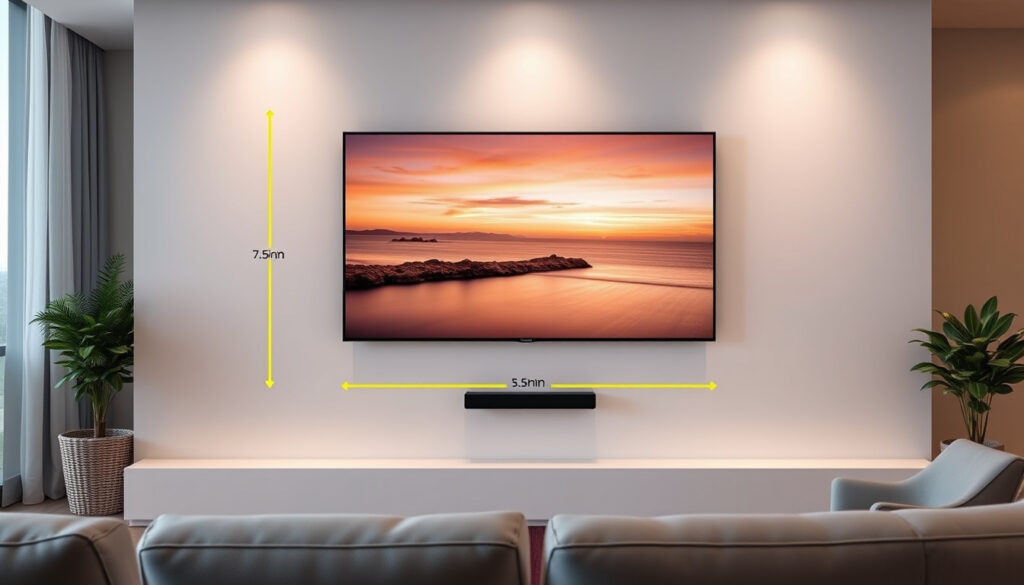
75 Inch TV Dimensions: Width, Height & Depth Guide
You know the screen is 75 inches diagonally, but that number says almost nothing about whether the TV will actually fit your wall or stand. The real dimensions — width, height, and depth — vary by brand and model, and a few inches of bezel or a bulky stand can make the difference between a clean installation and a headache. This guide uses verified measurements from major manufacturers like Samsung, Sony, LG, and TCL to give you the concrete numbers you need, plus a practical method for checking fit before you buy.
Screen diagonal: 75 inches (190.5 cm) ·
Typical width without stand: 66 inches (167.6 cm) ·
Typical height without stand: 37 inches (94 cm) ·
Typical depth without stand: 2.5–4 inches (6.4–10.2 cm) ·
Recommended viewing distance: 7.5–12.5 feet (2.3–3.8 m)
Quick snapshot
- 75 inches refers to the diagonal screen measurement, not width or height. (TCL consumer electronics brand)
- Typical width without stand: ~66 inches (167.6 cm). (Fitueyes TV accessories guide)
- Samsung 75-inch dimensions: approximately 166 x 95 cm. (Samsung Malaysia official store)
- Sony X950G 75-inch: 167.6 x 96.2 x 7.3 cm (width x height x depth). (Dimensions.com technical spec database)
- Exact depth for many models isn’t standardized; check the specific product spec sheet. (Fitueyes TV accessories guide)
- Dimensions with a stand can add 2–6 inches in height and depth, depending on the design. (Fitueyes TV accessories guide)
- Weight varies significantly by model, ranging from 55 to 75 pounds without stand. (Fitueyes TV accessories guide)
- Shipping box dimensions are considerably larger than the TV itself, typically 72×44×12 inches. (Fitueyes TV accessories guide)
- No significant timeline changes: 75-inch TV dimensions have been consistent over recent years, with bezel sizes slightly shrinking. (TCL consumer electronics brand)
- Before buying, measure your wall or stand width and add 3–5 inches clearance on each side. (Fitueyes TV accessories guide)
Here is a summary of the key measurements every buyer needs.
| Measurement | Value |
|---|---|
| Diagonal screen size | 75 inches (190.5 cm) |
| Typical width (without stand) | 66 inches (167.6 cm) |
| Typical height (without stand) | 37 inches (94 cm) |
| Typical depth (without stand) | 2.5–4 inches (6.4–10.2 cm) |
| Recommended viewing distance | 7.5–12.5 feet (2.3–3.8 m) |
What is the true size of a 75 inch TV?
Understanding screen diagonal vs. overall dimensions
The “75 inch” label always refers to the diagonal measurement — from one corner of the display to the opposite corner, not including the bezel. Most modern 75-inch TVs use a 16:9 aspect ratio, meaning the screen width is about 87% of the diagonal, and the height about 49%. Using the Pythagorean theorem, a 16:9 screen at 75 inches yields a screen area roughly 65.4 inches wide by 36.8 inches tall. (TCL consumer electronics brand)
But the actual chassis is larger. The bezel — the frame around the screen — adds anywhere from 0.5 to 2 inches on each side depending on the model. That’s why a 75-inch TV’s overall width typically lands around 66 inches (167.6 cm), and its height around 37 inches (94 cm). (TCL consumer electronics brand)
Typical width, height, and depth without stand
Without a stand, the depth is surprisingly slim: most 75-inch TVs measure between 2.5 and 4 inches (6.4 to 10.2 cm) deep. That’s thin enough for a flush wall mount. The Samsung 75-inch Q80C, for example, has a depth of about 2.5 inches (Samsung Malaysia official store), while the Sony X950G reaches 2.875 inches (7.3 cm). (Dimensions.com technical spec database) Height adds another 2–6 inches if you use the included stand because the legs or pedestal push the TV upward.
The implication: The diagonal number is a quick spec, but the width is the dimension that matters most for placement. If you only check the diagonal, you risk buying a TV that overhangs your entertainment center by several inches.
How big is a 75 inch TV in centimeters?
Converting inches to centimeters for width, height, and depth
One inch equals 2.54 cm, so a 75-inch diagonal is exactly 190.5 cm. For the overall dimensions, the conversion is straightforward:
- Width: 66 in × 2.54 = 167.6 cm
- Height: 37 in × 2.54 = 94 cm
- Depth: 2.5–4 in × 2.54 = 6.4–10.2 cm
Most retailers and manufacturers (including TCL and Appliances Online appliance retailer) round the metric figures to 168 cm wide and 97 cm tall, which accounts for slight variations in bezel design.
Exact metric dimensions for common 75-inch TV models
Here are the manufacturer-stated metric dimensions for popular 75-inch models:
- Samsung 75-inch (e.g., Q80C): 166 cm wide × 95 cm tall × 6.4 cm deep (without stand). (Samsung Malaysia official store)
- Sony X950G 75-inch: 167.6 cm wide × 96.2 cm tall × 7.3 cm deep (without stand). (Dimensions.com technical spec database)
- LG 75-inch (e.g., UQ8000): 167.6 cm wide × 96.5 cm tall × 8.9 cm deep (without stand). (Dimensions.com technical spec database)
- TCL 75-inch (e.g., QM6K): 167.6 cm wide × 94 cm tall × 7.6 cm deep (without stand). (TCL consumer electronics brand)
The differences may seem small — a few centimeters here and there — but that extra width can determine whether a TV fits your existing cabinet or forces you to buy a new stand. Samsung’s 166 cm width, for instance, shaves about 1.6 cm off the Sony and LG models, a meaningful gap for tight spaces.
Are all 75 inch TVs the same dimensions?
No — and the differences matter for both wall mounting and stand placement. Four brands, four slightly different footprints.
5 models, one pattern: the widest is only 1.6 cm more than the narrowest, but height and depth vary more noticeably.
| Brand / Model | Width (cm) | Height (cm) | Depth (cm) | Source |
|---|---|---|---|---|
| Samsung 75″ Q80C | 166.0 | 95.0 | 6.4 | Samsung Malaysia |
| Sony 75″ X950G | 167.6 | 96.2 | 7.3 | Dimensions.com |
| LG 75″ UQ8000 | 167.6 | 96.5 | 8.9 | Dimensions.com |
| TCL 75″ QM6K | 167.6 | 94.0 | 7.6 | TCL |
How bezel size and stand design affect overall dimensions
Bezels have shrunk dramatically over the past five years, but they’re not gone. Samsung’s “Infinity One” design on the Q80C uses a nearly bezel-less front, which is why its width is slightly less than competing models. LG and Sony still use a thin metal frame that adds about 0.5 inches per side. The stand is the bigger variable: some TVs use a central pedestal (Samsung), others use two wide-spaced legs (Sony, TCL). Central pedestals keep the width unchanged, but wide legs may require a stand that is at least as wide as the TV to avoid overhang. (Fitueyes TV accessories guide)
If you buy a Sony or TCL with wide legs, assume the TV stand needs to be 70–75 inches wide — not just 66 inches. A narrower stand will leave the legs hanging unsupported, which is a safety risk.
The trade-off: Samsung saves 1.6 cm of width by trimming the bezel, but its central pedestal may require a deeper stand. Sony and LG use a wider bezel but offer more stable leg placement. Your room dimensions will decide which trade-off works.
How to know if a 75 inch TV is too big
Room size and viewing distance guidelines
The Society of Motion Picture and Television Engineers (SMPTE) recommends a viewing angle of 30 degrees, which for a 75-inch TV translates to a distance of about 7.5–12.5 feet (2.3–3.8 m). (TCL consumer electronics brand) Some guides suggest a tighter range of 6.5–10 feet for 4K content, where you can sit closer without seeing pixels. (Fitueyes TV accessories guide)
If your couch is less than 6.5 feet from the wall, a 75-inch TV will likely feel overwhelming — you’ll have to move your head to see the edges. For rooms deeper than 12 feet, the TV will start to feel small.
Measuring your wall and entertainment center
Grab a tape measure. The wall area needed is at least 70 inches wide (TV width + 2 inches clearance on each side) and 42 inches tall (TV height + 2–3 inches above and below). If mounting above a fireplace, add 6 inches for the television’s height plus clearance. For a stand or cabinet, the surface must be at least 70 inches wide and 20 inches deep to accommodate the TV’s width and the stand’s footprint. (Fitueyes TV accessories guide)
The catch: the TV’s shipping box is much larger — typically 72×44×12 inches (183×112×30 cm). Measure your doorways, elevator, and stairwell to ensure you can get the box into the room.
A 75-inch TV is 8 times the screen area of a 32-inch TV. Buyers in apartments with tight hallways or narrow stairs: the TV might fit the wall perfectly, but if the box can’t get through the front door, you’ve got a return on your hands.
How to measure TV dimensions correctly
Measuring screen diagonal vs. full TV dimensions
The screen diagonal is the standard marketing number, but it’s useless for fit. You need three numbers: width, height, and depth. Width and height should be measured at the widest points of the chassis (including bezel). Depth is measured from the back of the TV to the front of the screen (without stand). If you’re placing on a stand, also measure the TV’s height with the stand attached.
Tools needed and step-by-step process
- Get a tape measure — a flexible metal tape is best. A laser measure works but isn’t necessary.
- Width: Run the tape from the left edge to the right edge of the TV’s frame. Record in inches and centimeters.
- Height: Measure from the bottom edge to the top edge. If using a stand, measure from the surface to the top of the TV.
- Depth: Place the tape at the thickest part of the back panel and measure to the front bezel. This is usually near the input ports.
- Check the box dimensions — look for the shipping dimensions on the product page. They’re always larger than the TV itself.
Most TV product pages on the manufacturer’s website include a “Specifications” section with these numbers. For example, Samsung’s official site lists the Q80C dimensions as 166.0 x 95.0 x 6.4 cm (WxHxD) without stand. (Samsung Malaysia official store)
The pattern: The manufacturer’s spec sheet is your single source of truth. Retailers sometimes round dimensions, so always cross-check against the brand’s own data sheet.
What we know and what’s unclear
Confirmed facts
- 75-inch TV diagonal is exactly 75 inches (190.5 cm). (Fitueyes TV accessories guide)
- Samsung 75-inch dimensions: ~166 x 95 cm. (Samsung Malaysia official store)
- Sony X950G 75-inch dimensions: 167.6 x 96.2 cm. (Dimensions.com technical spec database)
- TCL 75-inch width: ~167.6 cm. (TCL consumer electronics brand)
What’s unclear
- Exact depth for all models varies; check specific product specs. (Fitueyes TV accessories guide)
- Dimensions with stand can add 2–6 inches in height and depth depending on design.
- Weight specifications are not standardized across brands.
“Measuring approximately 166 x 95 cm or 65 x 37 inches.”
— Samsung Malaysia TV buying guide
“Height of 37.875″ (96.2 cm), width of 66″ (167.6 cm), depth of 2.875″ (7.3 cm).”
— Dimensions.com entry for Sony X950G
For apartment dwellers in Singapore or other dense cities, the practical takeaway is clear: a 75-inch TV is a major physical commitment. The width alone (66–67 inches) means it will dominate most wall spaces. Before you buy, measure your elevator door, stairwell width, and the exact wall area. A few centimeters of clearance can save you from a costly mismatch — or a return process that’s even more annoying than the TV delivery.
For Singapore buyers shopping at Sim Lim Square or online retailers, the choice is clear: measure the TV’s exact width and depth from the brand’s spec sheet, not the diagonal. Then measure your room’s actual dimensions. A 75-inch TV fits most living rooms only if the wall is at least 72 inches wide and the viewing distance is 7.5 feet or more. Anything less, and you’ll either need to wall-mount or go with a 65-inch model.
Related reading: LG Stand By Me: Portable Touchscreen TV Review & Specs · Sim Lim Square Photos: A Visual Guide to Singapore’s Electronics Hub
rtings.com, businessinsider.com, youtube.com, samsung.com, instagram.com
For a detailed breakdown of how the 75-inch TV dimensions compare across brands, see this 75-inch TV dimensions guide from Southern Monitor.
Frequently asked questions
What is the width of a 75 inch TV?
Typically 66 inches (167.6 cm) without stand. Brands vary slightly; Samsung is about 166 cm, Sony and LG about 167.6 cm.
What is the height of a 75 inch TV?
Approximately 37 inches (94 cm) without stand. With a stand, add 2–6 inches depending on the model.
How deep is a 75 inch TV?
Without stand, 2.5 to 4 inches (6.4–10.2 cm). Depth varies by model and will be thicker at the input panel area.
Does the stand affect the dimensions of a 75 inch TV?
Yes. A stand typically adds 2–6 inches to the height and can increase depth by 8–12 inches depending on the design (central pedestal vs. wide legs).
Can a 75 inch TV fit in a standard entertainment center?
Only if the entertainment center is at least 70 inches wide and 20 inches deep. Most standard cabinets designed for 65-inch TVs or smaller will be too narrow.
What is the viewing distance for a 75 inch TV?
7.5–12.5 feet (2.3–3.8 m) for standard content. For 4K content, you can sit as close as 6.5 feet.
How much does a 75 inch TV weigh?
Weight varies by model but typically ranges from 55 to 75 pounds (25–34 kg) without stand. Check the product spec for exact weight.
More related posts
 D-Wave Share Price Analysis: Buy, Sell or Hold? (QBTS Stock)
 The Wiggles The Twelve Days of Christmas Lyrics & Meaning
 East Ocean Teochew Restaurant Closes After 33 Years: Menu, Reviews
 IndiGo Singapore to Chennai Flights: Fares & Baggage
 Kim Sun-young Actress: Bio, Roles, Family, K-Dramas
 Best French Bakeries Near Me: Dublin’s Top 2 & What to Try
 Best Islands to Visit in Greece: Safety, Budget & Top 5
 Civil Servant Year-End Bonus 2025: 1.3 Months & $600