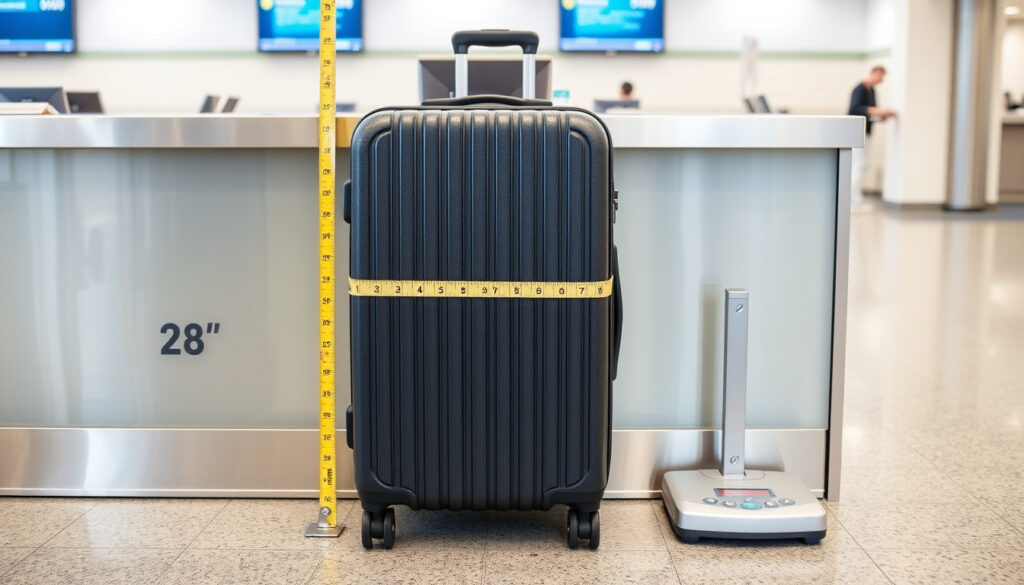
28 Inch Luggage Size: Dimensions, Weight & Airline Limits
That moment when your suitcase looks perfectly normal at home but suddenly feels like a small car at the airport check-in counter — it’s a traveler’s classic anxiety, and a 28-inch suitcase sits right at the edge of what most airlines allow. Whether it works for your trip comes down to three measurable things: total linear dimensions, weight restrictions, and the specific carrier’s rules.
Typical height (linear cm): 28 inches ≈ 71 cm ·
Common weight capacity: 15–25 kg for most models ·
Checked baggage requirement: Almost always too large for carry-on ·
Ryanair size limit: Maximum checked bag 81 cm (sum of 3 dimensions) ·
IATA total linear limit: 158 cm (sum of height, width, depth)
Quick snapshot
- Height: approx 71 cm (28 in) (IATA Passenger Baggage Rules)
- Width: approx 50 cm (20 in) (IATA Passenger Baggage Rules)
- Depth: approx 30 cm (12 in) (IATA Passenger Baggage Rules)
- Total linear: 151–160 cm (IATA Passenger Baggage Rules)
- Typical empty weight: 3–6 kg (IATA Passenger Baggage Rules)
- Maximum load: 15–25 kg (depending on build) (IATA Passenger Baggage Rules)
- Matches common airline 23 kg limit (IATA Passenger Baggage Rules)
- International flights (checked only) (American Airlines Checked Bag Policy)
- Trips of 2 weeks or more (Singapore Report)
- Family travel or heavy packers (Travelpro Checked Luggage Sizes)
- Too large for carry-on (American Airlines Bag Limitations)
- May exceed budget airline size limits (Singapore Report)
- Can be heavy to lift into overhead bins (American Airlines Bag Limitations)
Five key facts, one clear pattern: a 28-inch suitcase usually fits the standard checked-baggage limit, but the margin is tighter than most travelers expect.
| Measurement | Value | Source |
|---|---|---|
| Standard 28 inch linear total | 158 cm (IATA limit) | IATA Passenger Baggage Rules |
| Ryanair maximum height for checked bag | 81 cm (total linear 50+35+20=105 cm) | Singapore Report |
| Most common weight restriction on 28 inch | 23 kg (airline-imposed) | IATA Passenger Baggage Rules |
| Average empty weight of 28 inch hardside | 5 kg (range 4–7 kg) | Travelpro Checked Luggage Sizes |
| Typical volume | 85–110 litres (depending on depth) | Singapore Report |
The implication: a 28-inch bag’s total linear dimensions hover within 7–10 cm of the industry cap, so a slightly deeper or wider shell can push it into oversize territory.
What size is a 28 inch suitcase?
28 inch luggage size in cm
A 28-inch suitcase is measured by the sum of its three linear dimensions — height, width, and depth — not a single diagonal measurement. The industry standard calculation, defined by IATA Passenger Baggage Rules, uses external dimensions including wheels and handles.
- Height: approximately 71 cm (28 inches)
- Width: approximately 50 cm (20 inches)
- Depth: approximately 30 cm (12 inches)
- Total linear: 151–160 cm depending on the brand and shell design
A typical 28-inch suitcase measures roughly 28 x 18 x 12 inches, which totals 58 linear inches — under the 62-inch ceiling, according to Singapore Report. However, relying on the “28 inch” label alone is risky; always check airline-specific size limits before booking.
How to measure a 28 inch suitcase
- Place the suitcase on a flat surface with wheels down and handles retracted
- Measure height from the bottom of the wheels to the top of the handle
- Measure width from left to right at the widest point
- Measure depth from front to back, including pockets or compartments
- Add height + width + depth to get the total linear dimensions
Air Canada Checked Baggage guidance confirms that total linear dimensions include wheels and handles — an often-overlooked detail that can push a 28-inch bag past the limit if the handle adds extra centimetres.
A bag labeled “28 inch” from one brand may measure 160 cm total linear, while another brand’s “28 inch” bag comes in at 152 cm. The label alone is not a reliable standard.
The pattern: precise measurement is the only way to guarantee fit, and the label is just a starting point.
Can 28 inch luggage be checked in?
28 inch luggage size checked baggage
Yes — 28-inch suitcases are designed as checked baggage, never carry-on. IATA Passenger Baggage Rules specify that most major airlines allow checked bags up to 158 cm total linear dimensions, and a 28-inch suitcase typically fits within that.
A Horizn Studios luggage guide gives an example of a 77 × 52 × 28 cm bag totaling 157 cm, illustrating how a large checked suitcase can stay within the 158 cm benchmark. American Airlines Checked bag policy confirms the standard 158 cm / 62 in and 23 kg / 50 lb limit for most routes.
Airlines that accept 28 inch suitcases
- American Airlines: 158 cm / 62 in total, 23 kg in economy (American Airlines)
- Delta, United, Lufthansa: Follow the same 62 linear inch benchmark (Horizn Studios)
- Emirates: Up to 203 cm / 79.92 in total dimensions — more generous than most (Emirates Checked baggage)
- British Airways: Economy Basic often has no checked bag included; Economy includes one 23 kg bag (Skyscanner hold luggage guide)
Additionally, if you’re flying with Singapore Airlines, check their promotion codes for possible baggage allowance upgrades.
Why this matters: the airline’s total linear limit is the binding constraint, not the bag’s height alone. A 28-inch bag with deep packing capacity may still fit, but one with oversized handles or thick wheels can fail.
The catch: even if the bag fits, weight limits are enforced separately — a heavy empty bag can eat into your allowance.
How many kg can a 28 inch luggage hold?
28 inch luggage capacity in kg
Weight capacity depends on suitcase material (hard versus soft shell) and frame design. Travelpro Checked Luggage Sizes notes that the typical range is 15–25 kg of contents, with the empty bag itself weighing 3–6 kg for hardside models.
Does 28 inch luggage mean 23 kg?
No — the 23 kg limit is an airline weight restriction, not a suitcase capacity. IATA Passenger Baggage Rules recommends 23 kg per checked bag for occupational health and safety reasons, and most carriers enforce it for economy tickets.
A 28-inch suitcase may physically hold 23 kg, but overpacking can damage zippers or frames. If the empty bag weighs 5 kg and you pack 23 kg of contents, the total checked weight hits 28 kg — which exceeds the 23 kg limit on most tickets.
A lighter hard-shell bag (3.5 kg) leaves nearly 20 kg for your belongings, while a heavy-duty polycarbonate case (6 kg) leaves only 17 kg headroom before hitting the 23 kg ceiling.
What this means: the bag’s empty weight directly affects how much you can pack without exceeding airline limits.
Is a 28 inch suitcase too big?
Is a 28 inch suitcase too big for international travel?
Not too big for most international flights if checked — but it is always too large for carry-on. American Airlines Bag limitations state that any bag exceeding 62 linear inches is classified as oversize and incurs fees.
Might be too large for budget airlines with stricter linear limits. According to a report from Singapore Report, Ryanair’s checked-bag limit is 81 × 119 × 119 cm — meaning a 28-inch suitcase is usually constrained more by weight than by size on that carrier.
28 inch luggage size international
For international travel, consider trip length. A 28-inch suitcase works well for 2–3 weeks; a 24- or 26-inch bag may suffice for shorter trips and is easier to manoeuvre through train stations, buses, and narrow aisles.
The pattern: international carriers like Emirates Checked baggage that allow up to 203 cm total dimensions give you plenty of room, while short-haul budget airlines can make a 28-inch bag feel oversized.
If you’re transiting through Changi Airport, check our guide on what to do during layovers — especially if you’re traveling with a large bag.
The implication: a 28-inch bag is a good fit for international travel on full-service airlines, but budget carriers may require a smaller bag.
Is a 28 inch suitcase a good size?
Pros and cons of a 28 inch suitcase
Upsides
- Generous packing capacity (85–110 litres) for 2-3 week trips
- Fits within the standard 158 cm / 62 in limit on most full-service airlines
- Many models feature spinner wheels for easy manoeuvring
- Good for family travel or heavy packers who need extra volume
Downsides
- Heavy when full — empty weight of 4–7 kg eats into the 23 kg allowance
- Too large for carry-on; always requires checked baggage
- Can exceed budget airline size limits (e.g., Ryanair, easyJet)
- Difficult to handle in tight spaces, overhead bins, or public transport
What is the most popular size suitcase?
The most popular size internationally is 24–26 inches (medium check-in), according to luggage retailers and travel guides. A 28-inch suitcase suits travelers who prioritize volume above portability — typically those packing for longer stays, family trips, or cold-weather destinations requiring bulkier items.
The consequence for a traveler in the US or EU market is clear: choose a 28-inch bag when you need maximum volume and fly mainly with full-service carriers, or size down to 24-26 inches if you travel frequently on budget airlines or value ease of handling.
How to pack a 28 inch suitcase for a 2-week trip
- Pack clothes that mix and match to reduce total items
- Use packing cubes to compress clothes and maximise volume
- Place heavy items (shoes, toiletries) at the wheel end
- Weigh your bag at home — aim for 20–22 kg to stay under the 23 kg limit
- Check airline-specific weight and size limits before heading to the airport
Large suitcases can measure up to 80 cm x 55 cm. Always check your airline’s dimensions before booking.
Singapore Airlines permits checked luggage up to 158 cm total linear dimensions — accommodating a typical 28-inch case.
A 23 kg luggage allowance usually fits a large checked suitcase around 70–80 cm in height.
The pattern: a 28-inch bag is a good fit for travelers who prioritize capacity over convenience, but it’s not the most popular size for a reason — portability matters.
Summary
A 28-inch suitcase strikes a workable balance for most international travelers who check their bags — it fits within the standard 158 cm total linear limit and matches the common 23 kg weight allowance. The catch is that your actual bag’s dimensions, including wheels and handles, must be verified against each airline’s policy. For a US or EU traveler booking with full-service carriers, a 28-inch bag is a practical choice for trips over a week. For budget airline flyers, the decision is clear: size down to 26 inches, or risk oversize fees.
For a detailed breakdown of dimensions and airline policies, check out this 28-inch luggage size guide.
Frequently asked questions
Can I carry a 28 inch suitcase in the cabin?
No. A 28 inch suitcase is too large for carry-on — it exceeds airline cabin baggage size limits. It must be checked.
What airlines accept 28 inch checked luggage?
Most full-service airlines (American Airlines, Delta, United, British Airways, Emirates, Singapore Airlines) accept checked bags up to 158 cm or more. Budget carriers like Ryanair may have stricter limits.
How do I measure my suitcase to know if it is 28 inches?
Measure height (including wheels and handle), width, and depth. Add them together for the total linear dimensions. A typical 28 inch bag totals 151–160 cm.
Is a 28 inch suitcase heavy?
Empty, a typical hard-shell 28 inch suitcase weighs 4–7 kg. When loaded to the 23 kg limit, the bag can feel quite heavy to lift and manoeuvre.
Can I pack 30 kg in a 28 inch suitcase?
Physically possible for some models, but most airlines limit checked bags to 23 kg in economy. Exceeding 32 kg is often prohibited entirely by safety regulations.
What is the volume of a typical 28 inch suitcase?
Between 85 and 110 litres, depending on the bag’s depth and shell design. Hard-shell cases tend toward the lower end; soft-shell bags can reach higher volumes.
Is 28 inch luggage bigger than 30 inch?
No — a 30 inch suitcase is larger. The height difference is about 5 cm, and a 30 inch bag may push past the 158 cm limit, making it oversize on most airlines.
Does a 28 inch suitcase fit in a car trunk?
Usually yes, but compact cars require folding seats. Always measure your car’s trunk opening before purchasing.
More related posts
 Man City vs Wolves: 2025/26 Results, H2H & Injury Updates
 Marina Bay Sand New Tower: $8 Billion Re ort Expan ion
 SGD to Chinese Yuan: Rate, Conversion & Why the Yuan Is Falling
 Dota 2 TI 2025: Location, Winner, Prize Pool, Schedule
 Sheng Siong Weekly Special Deals 2026: Discounts & Guide
 South Korea Public Holidays 2025: Dates and Full List
 Google Translate English to Burmese: Does It Work
 D-Wave Share Price Analysis: Buy, Sell or Hold? (QBTS Stock)