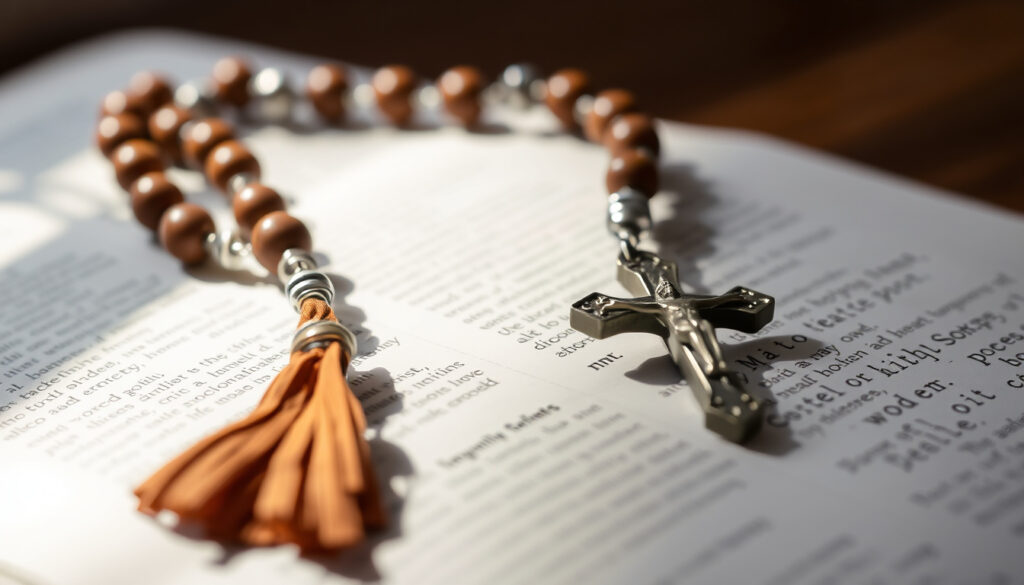
How to Pray the Rosary: Step-by-Step Guide
Anyone who has picked up a rosary and felt unsure where to start knows the feeling. The Rosary is one of the most treasured Catholic prayers, but its sequence of beads and mysteries can seem complicated at first. This guide walks you through every step — from the opening Sign of the Cross to the final Hail Holy Queen — with the full prayers, the four mystery sets, and practical tips for daily practice.
Rosary beads used worldwide: over 1 billion Catholics · Mystery sets in the Rosary: 4 (Joyful, Luminous, Sorrowful, Glorious) · Hail Marys in a full Rosary: 53 · Our Fathers in a full Rosary: 6 · Year the Rosary was formalized: 1569 (Pope Pius V)
Quick snapshot
- The Rosary includes the Apostles’ Creed, Our Father, Hail Mary, Glory Be, and Hail Holy Queen (FOCUS (Catholic campus ministry))
- The four sets of mysteries are Joyful, Luminous, Sorrowful, and Glorious (The Catholic Company (Catholic retailer))
- The Luminous Mysteries were added by Pope John Paul II in 2002 (Vatican (Holy See official))
- The exact origin of the Rosary is debated among historians (New Advent (Catholic encyclopedia))
- Some sources attribute the Rosary to St. Dominic, but evidence is limited (New Advent (Catholic encyclopedia))
- : Pope Pius V formalized the Rosary in the papal bull Consueverunt Romani Pontifices (Vatican (Holy See official))
- : Pope John Paul II added the Luminous Mysteries (Vatican (Holy See official))
- Daily Rosary practice is encouraged by the Catholic Church (USCCB (U.S. bishops’ conference))
- One decade takes about 5 minutes, making it easy to fit into a busy day (Hallow (Catholic prayer app))
| Attribute | Value |
|---|---|
| Origin | Tradition traces to St. Dominic in the 13th century (New Advent) |
| Official approval | Pope Pius V formalized the Rosary in 1569 (Vatican) |
| Mystery sets | 4: Joyful, Luminous, Sorrowful, Glorious (The Catholic Company) |
| Total prayers in one Rosary | 53 Hail Marys, 6 Our Fathers, 5 Glory Bes (FOCUS) |
| Patron saint | Our Lady of the Rosary (feast day October 7) (USCCB) |
| Optional prayers | Fatima Prayer, Scripture readings before each decade (Catholic Woodworker) |
How do you pray the Rosary step by step?
Beginners often treat the Rosary as a rote repetition, but the Church emphasizes it as a meditation on Christ’s life. The real challenge is not the words — it’s staying focused on the mystery while you pray.
Make the Sign of the Cross and pray the Apostles’ Creed
- Hold the crucifix and make the Sign of the Cross. Pray the Apostles’ Creed while holding the crucifix (FOCUS).
Pray the Our Father on the first large bead
- Move to the first large bead and pray the Our Father (The Catholic Company).
Pray three Hail Marys on the next three beads
- On the next three small beads, pray one Hail Mary each — traditionally offered for faith, hope, and charity (Catholic Woodworker).
Pray the Glory Be and announce the first mystery
- After the three Hail Marys, pray the Glory Be. Then announce the first mystery of the day (e.g., “The First Joyful Mystery — The Annunciation”) (Maryknoll Sisters).
Pray one Our Father and ten Hail Marys per decade
- Each decade begins with one Our Father on the large bead, followed by ten Hail Marys on the small beads. After the tenth Hail Mary, pray the Glory Be and, optionally, the Fatima Prayer (Catholic Woodworker). Repeat for all five decades.
Conclude with the Hail Holy Queen and Sign of the Cross
- After the fifth decade, pray the Hail Holy Queen, then make the Sign of the Cross (FOCUS).
The implication: each decade is a mini-meditation on a specific event from the Gospels. If you lose focus, pause and read a short Scripture verse related to that mystery before continuing.
What are the 5 mysteries of the rosary and days?
Knowing which mysteries to pray on which day turns an occasional prayer into a habitual rhythm. The pattern below is the most widely used in the Latin Church.
Joyful Mysteries (Monday and Saturday)
- The Annunciation — Mary learns she will bear Jesus.
- The Visitation — Mary visits Elizabeth.
- The Nativity — Jesus is born.
- The Presentation — Jesus is presented in the Temple.
- The Finding in the Temple — Jesus is found teaching. (The Catholic Company)
Luminous Mysteries (Thursday)
- The Baptism of Jesus — Jesus is baptized in the Jordan.
- The Wedding at Cana — Jesus performs his first miracle.
- The Proclamation of the Kingdom — Jesus calls for conversion.
- The Transfiguration — Jesus is transfigured on the mountain.
- The Institution of the Eucharist — Jesus gives us the Eucharist. (Vatican — Rosarium Virginis Mariae)
Sorrowful Mysteries (Tuesday and Friday)
- The Agony in the Garden — Jesus prays in Gethsemane.
- The Scourging at the Pillar — Jesus is scourged.
- The Crowning with Thorns — Jesus is crowned with thorns.
- The Carrying of the Cross — Jesus carries his cross.
- The Crucifixion — Jesus dies on the cross. (The Catholic Company)
Glorious Mysteries (Wednesday and Sunday)
- The Resurrection — Jesus rises from the dead.
- The Ascension — Jesus ascends into heaven.
- The Descent of the Holy Spirit — The Holy Spirit comes at Pentecost.
- The Assumption — Mary is taken into heaven.
- The Coronation — Mary is crowned Queen of Heaven. (USCCB)
The trade-off: the four sets cover the entire life of Christ. Praying them in weekly rotation means you meditate on the whole Gospel in a structured way.
How to pray the Rosary for beginners?
Use a Rosary bead set to keep count
- The beads are not required, but they free your mind to focus on the mysteries. Each bead corresponds to a prayer, so you never lose your place (Maryknoll Sisters).
Start with the crucifix and work through the beads
- The Rosary follows a fixed sequence: crucifix → first large bead → three small beads → chain → then five decades in order (FOCUS).
Meditate on the mystery while praying each decade
- Set aside mental space for the mystery. You can read a related Scripture verse before the decade, then let the words of the Hail Mary form a background rhythm (FOCUS).
Practice with a printable PDF guide
- Print a one-page Rosary guide that lists the prayers and mysteries. Keep it with your beads until the sequence becomes automatic (Catholic Woodworker).
The catch: the habit forms faster if you pray the same time and place each day. Even one decade with full attention beats five decades rushed.
What is the Rosary prayer in English?
Six prayers form the backbone of the Rosary. Below are the standard English versions used in most Catholic parishes.
Apostles’ Creed
- “I believe in God, the Father almighty, Creator of heaven and earth…” — prayed on the crucifix (FOCUS).
Our Father
- “Our Father, who art in heaven, hallowed be thy name…” — prayed at the start of each decade (The Catholic Company).
Hail Mary
- “Hail Mary, full of grace, the Lord is with thee…” — repeated 53 times in a full Rosary (The Catholic Company).
Glory Be
- “Glory be to the Father, and to the Son, and to the Holy Spirit…” — prayed after each decade (FOCUS).
Hail Holy Queen
- “Hail, Holy Queen, Mother of Mercy, our life, our sweetness, and our hope…” — prayed at the conclusion (USCCB).
How to pray the Rosary everyday?
Set a consistent time each day
- Morning, commute, or before bed — pick a slot and stick to it. Consistency beats duration (Hallow).
Use a Rosary app or audio guide
- Apps like Hallow or Laudate provide audio-led Rosaries with mystery prompts, perfect for beginners (Hallow).
Pray one decade if time is limited
- A single decade takes about 5 minutes. Many saints recommended praying at least one decade daily rather than skipping entirely (Hallow).
Follow the assigned mysteries for each day
- Use the Monday/Saturday Joyful, Tuesday/Friday Sorrowful, Thursday Luminous, Wednesday/Sunday Glorious pattern to keep variety and cover all mysteries each week (The Catholic Company).
Daily Rosary prayer is simple in structure but difficult in practice — the distractions of modern life fight the stillness needed for meditation. The Church’s answer: start small, use a guide, and remember that the Rosary is a prayer, not a performance.
Timeline of the Rosary
- — Tradition holds that St. Dominic received the Rosary from the Virgin Mary (New Advent).
- — Pope Pius V formalized the Rosary in the bull Consueverunt Romani Pontifices (Vatican).
- — Our Lady of Fatima asks for daily Rosary, and the Fatima Prayer is later appended (Vatican).
- — Pope John Paul II adds the Luminous Mysteries in Rosarium Virginis Mariae (Vatican).
What this means: the Rosary has evolved over centuries, but its core structure has remained stable since the 16th century. The addition of the Luminous Mysteries shows the Church adapting the devotion without breaking tradition.
What is confirmed and what is unclear about the Rosary
Confirmed facts
- The Rosary includes the Apostles’ Creed, Our Father, Hail Mary, Glory Be, and Hail Holy Queen (FOCUS).
- The four sets of mysteries are Joyful, Luminous, Sorrowful, and Glorious (The Catholic Company).
- The Luminous Mysteries were added by Pope John Paul II in 2002 (Vatican).
What’s unclear
- The exact origin of the Rosary is debated among historians (New Advent).
- Some sources attribute the Rosary to St. Dominic, but evidence is limited (New Advent).
Voices on the Rosary
“The Rosary, though clearly Marian in character, is a prayer centered on Christ. … With the Rosary, the Christian people sits at the school of Mary and is led to contemplate the beauty of the face of Christ.”
— Pope John Paul II, Rosarium Virginis Mariae (2002) (Vatican)
“When I pray the Rosary, I find it hard to concentrate — my mind wanders, and the words feel empty. But I keep praying it anyway, because it is the prayer of the poor and the simple.”
— St. Thérèse of Lisieux, as recounted by Fr. Gabe Cillo (The Catholic Company)
“Meditation on the mysteries of the Rosary … is a form of Christian meditation that helps us to become more like Christ.”
— Catechism of the Catholic Church, no. 2708 (USCCB)
Summary
The Rosary is a structured meditation on the life of Christ, prayed with beads and specific prayers. It requires nothing more than willingness — no special training, no expensive tools. For the beginner who wants to start today, the choice is clear: pick up a set of beads, choose the day’s mysteries from the table above, and walk through one decade at a time. Skip the perfectionism; the Church says even one decade prayed with intention is a worthy offering.
Frequently asked questions
How long does it take to pray the Rosary?
A full five-decade Rosary takes about 15 to 25 minutes. A single decade takes roughly 5 minutes (Hallow).
Can I pray the Rosary without beads?
Yes. You can count prayers on your fingers, use a phone app, or simply keep track mentally. Beads are a traditional aid, not a requirement (Maryknoll Sisters).
What is the Fatima Prayer?
“O my Jesus, forgive us our sins, save us from the fires of hell, and lead all souls to heaven, especially those in most need of thy mercy.” It is commonly prayed after the Glory Be at the end of each decade (Catholic Woodworker).
Do I have to pray all five decades at once?
No. You can spread them throughout the day — one decade in the morning, another at lunch, and so on. Many Catholics pray only one decade if time is short (Hallow).
What if I miss a day?
Simply resume the next day. The Rosary is a devotion, not an obligation under pain of sin. Consistency is encouraged, but missing a day does not undo the grace of previous prayers (USCCB).
Is the Rosary only for Catholics?
While it is a distinctly Catholic devotion, Christians of other traditions sometimes pray it for meditation. The Rosary’s focus on Gospel events makes it accessible to anyone who reveres the life of Christ (The Catholic Company).
What is the difference between the Rosary and a chaplet?
A chaplet is any string of beads used for devotional prayer; the Rosary is a specific chaplet with a fixed sequence of prayers and mysteries. Other chaplets (e.g., Divine Mercy Chaplet) have different structures (New Advent).
More related posts
 Best 1-for-1 Buffet Singapore 2026: Prices, Deals & Cards
 One UI 8 Release Date: When Will Your Samsung Get the Update
 Alice in Borderland Cast: Full Season 1, 2 & 3 Guide
 SGD to Chinese Yuan: Rate, Conversion & Why the Yuan Is Falling
 Halal Cake Shop Singapore: Prices, Delivery & Certification Guide
 Tiffany & Co. Necklaces: Cost, Value & Authenticity
 Park Bo-gum: Career, Rumors, and His Ireland Trip in 2024
 Popeyes Kallang Wave Mall: Menu, Prices, Hours & More